Startup Lessons Learned: Want feedback? Just ask!

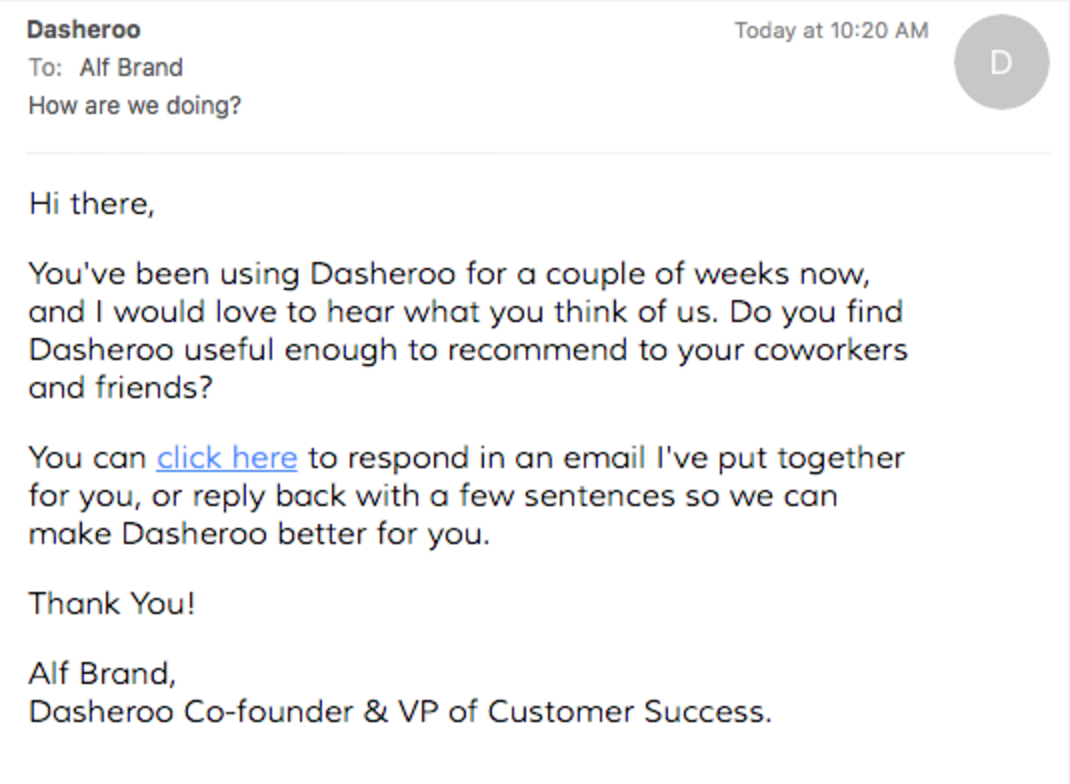
We’re big fans of survey tools like SurveyMonkey as well as in-app NPS tools like Wootric. They are great ways to get intel to help improve the user experience. But our co-founder and VP Customer Success wanted more! Similar to the email that is sent upon initial signup, asking users where they heard of us, So he created a short & sweet text only email asking 2 simple questions:

Here's Alf's simple & straightforward email

Here’s Alf’s simple & straightforward email

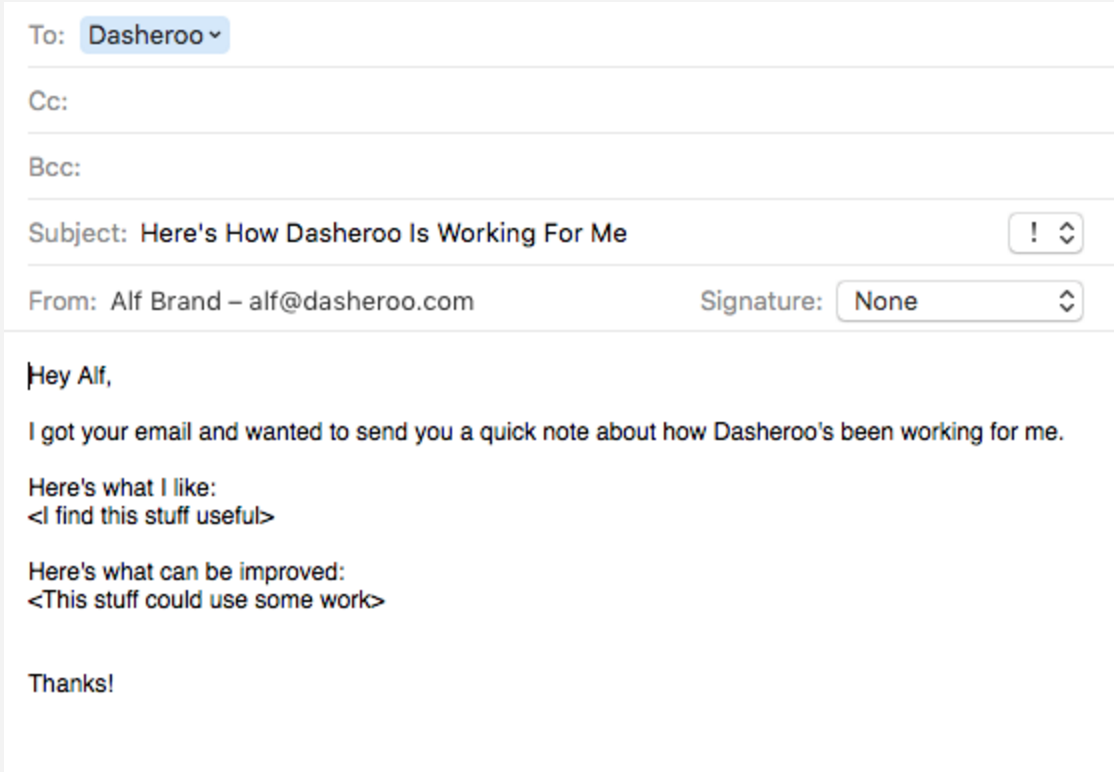
About 1/2 the folks reply directly to the email and the rest click on the link, which pops this pre-formed email:

Screen Shot 2016-05-25 at 10.34.17 AM

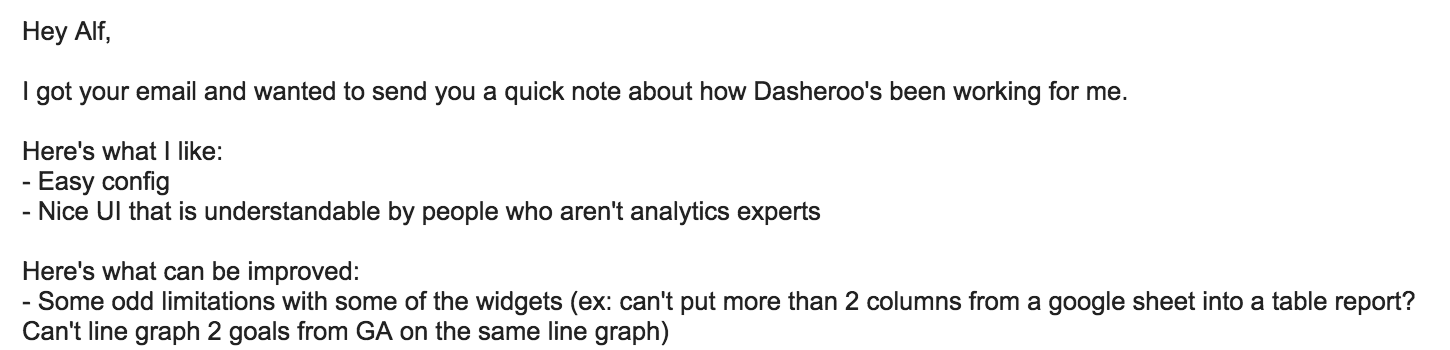
We get about a 4% response to this campaign, which is sent to users about 3 weeks after they sign up. They’ve had enough time to poke around, set up a dashboard or two and see what’s good and not so good. And this feedback is free and awesome! Sure it’s helpful to know what people appreciate but it’s way more valuable for us to know what’s missing for them. And in our case, we had a ton of common criticism about our original Google Sheets integration, specifically about the data set limitations. Here’s an actual email response:

Dasheroo Google Sheets feedback

Who knows, maybe we wouldn’t have thought to pose that question in a survey. We may not have ever found out that someone had an issue with Dasheroo and Google Sheets. But open-ended feedback rules! We’ll continue to build out these campaigns for additional steps in the customer journey to make sure we’re providing the best value and experience possible. What are your procedures and practices for doing the same, let’s learn from each other!

Startup Lessons Learned: Revenue Reconciliation

Screen Shot 2016-03-21 at 4.25.09 PMIn the early days of just about any startup, any sale seems like a good sale, right? And that’s great. But early on, before you have fancy accountants and real revenue recognition processes, it’s easy to let things get a bit sloppy in terms of reconciling sales, because hey, any sale’s a good sale, right?!

Recently I started spotting a few small inconsistencies in our sales reporting. Our bank account said one thing, our manual sales reporting another, our billing system another. Now, I’m just talking a few hundred bucks, but as sales grow month over month, a few hundy can turn into thousands if you don’t identify gaps in your reporting and plug them…now.

So what to do? First, identify your reporting sources. For us, we use Stripe for credit card processing. We use Salesforce.com to record our sales contracts. We also back that up with an old school Google Sheet since we don’t have all the bells and whistles we need in SFDC yet. We use Quickbooks Online for accounting. And we bank with First Republic.

If you get on this early, it’s really pretty easy to spot some omissions or simply mis-understanding or gaps in the process. What’d I find?

  • We have a handful of 6 and 12-month prepays in Stripe. So that entire payment tracked as single month monthly recurring revenue, and overstated our MRR. We’ve fixed that problem!
  • We had a few larger deals that (even though we really push for credit cards), were invoiced but it wasn’t clearly noted that this was the case. So that understated our revenue, plus since there is almost always a lag in payment on invoices, they weren’t reflected in our P&L either. We now flag these in Salesforce and in our old school Google Sheet and it all rolls into QBO and eventually into our P&L.

That brought things into line! Now, are we prepared for daily revenue recognition? Nope. But we’re now tracking very closely to actuals on all fronts. Who’s job is this to do in a small start-up? Yours, if you’re the CEO.

Startup Lessons: Setting Quotas for SaaS Salespeople

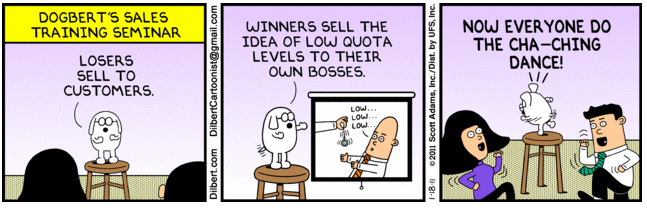
Sales cartoon - Dilbert

Image: Dilbert

Here at Dasheroo, 2016 is the year of sales! We launched our business dashboards mid-year 2015 and spent much of the
balance of the year adding more data sources, reports and other cool features. We’ve also been knee-deep, or maybe ‘ear-deep’ in listening to what our target users need in order to derive value from us. Because where value lies, sales happen.

And for sure, we earned some great customers in 2015. But now we have tons of learnings to leverage and an entire year to rock the sales machine.

So the next logical challenge is: how the hell to set aggressive, yet achievable, goals for my growing sales team that both challenges and fairly rewards them in our software-as-a-service (SaaS) model?

First you have to match your offering, complexity of sale and price (Annual Contract Value) to the appropriate level of sales person and their compensation. Meaning, don’t hire a 15-year enterprise sales veteran to sell a $3,000 per year SaaS deal. The math just won’t work. But typically that’s not an issue, as any enterprise sales person worth a damn wouldn’t take that job. The reverse can sometimes bite you though – don’t cheap out and hire a junior salesperson hoping they’ll land $1MM deals.

Here’s some top considerations:

  • Market segment(s) you are selling to. For instance, we sell to a lot of agencies, so we have a salesperson who has experience speaking to and selling into that unique market.
  • Type of sell. Is it a “1 call to close” or more of a traditional sale that goes thru the lead-qualify-demo-nurture-negotiate-close process. We’re hiring an SDR (Sales Development Rep) at a relatively low compensation package to handle the former type of sale, and our more experienced folks for the more process-driven sales.
  • Annual Contract Value (ACV). Typically the higher the ACV, the higher the quota and the higher the compensation you’ll pay a salesperson to generate those sales. And if you’re selling in to several segments (agencies, mid-size teams and enterprise) each will have its own ACV.
  • On Target Earnings (OTE). This is the total compensation (salary + commission) you’ll pay at each level. You may have to do some competitive research or speak with some industry colleagues. I’m lucky to have Rob Brewster, a kick-ass sales executive as an advisor. Bottom line, you have to have at least a ballpark on what sales folks are making at the low through high levels.

Once you have that baseline information nailed, it’s time to generate some quotas (your SaaS quotas should be on Annual Recurring Revenue). For SaaS businesses, the general guideline is to apply a multiplier of 3-4X to OTE. Here’s a quick example:

example of software as a service sales rep quota

Here, we began with estimated OTE for each level of sales, and applied a 3.5X OTE multiplier to arrive at the annual sales quota. Then you need a reality check based on average deal size (Target ACV). You have to balance that against the number of deals they’d have to close in a month or quarter to achieve that goal.

If it seems realistic, you’re onto something! If not, you need to take another look at one of your drivers: your pricing and ACV, your compensation plan or how you can accelerate the number of deals that can be closed in each month.

That’s why setting quotas for your SaaS salespeople is both a science and an art, as you can use some industry benchmarks as a framework for your plan, but it’s typical to nudge them a bit to create a reasonably aggressive plan that fits your business.

There’s a lot of other smart advice out there on this topic. Venture guy Jason Lemkin has written several excellent articles, and I learned a lot from him while establishing our plan.

What’s your experience, challenges and success creating your SaaS sales plan and setting quotas for your sales team? Let me know!

Startup Lesson: Business Process Focus – When Your Team Is Under Water

Cartoon about business process for business dashboard startup DasherooAhh, start-up land…finite resources and infinite things to get done! And all of those projects can appear to be critical to your success – or survival – right now. And if you don’t have a clear business process, you and your team can feel, well, under water.

At our business dashboard startup Dasheroo, we’re so excited to launch new features, integrate with more applications, get more traffic in the door and improve our in-app experience, that it can be dizzying at times.

And recently, I started to feel the springs almost starting to pop. You’ve probably been there, too. Progess? Sure, but not enough projects getting pulled over the finish line. Too many projects stuck in that ‘WIP’ category for too long.

And when that starts to happen, it’s time to reboot! And that means regrouping with the team, having an open discussion, focusing on the real priorities (maybe re-prioritizing), a real business process and executing.

We had a great meeting recently, where we revisited each major deliverable for Q4 across marketing, product, sales and engineering. It resulted in us taking a few things off of our plate, at least for now. Just agreeing that “we’re not gonna do that” this quarter. Or, “we thought that feature was really important a few months ago, but now that we’ve learned more it really isn’t mission critical’” It’s sobering, necessary and productive.

So what are some of the actions we took?

  • We delayed one big engineering project to Q1, and re-scoped another one that dramatically reduced (almost eliminated) additional engineering time. That meant we can focus on and complete a couple immediate revenue-generating projects – Insight alerts, branded dashboard exports and an agency & partner console that were all stuck in that ‘we’re almost there’ category.
  • We took a hard look at which social media and content outlets were providing us the best (and worst) results, and adjusted our publishing schedule to optimize the time spent on writing and socializing articles so we could spend more time developing a pricing test and a new onboarding experience.
  • We decided to take a couple app integrations off the Q4 table and focus on two key integrations that are more deep, more valuable and focused on driving user acquisition in a key market.

Although these discussions usually come a little too late, it’s the nature of the beast. I’ll try to get a better read on the ol’ ‘under water’ crystal ball, but the bottom line is addressing these issues immediately, getting everyone on the same page, and executing!

How do you identify and resolve business prioritization in your company? Let me know!

Startup Lessons Learned: Establishing Conversion KPIs

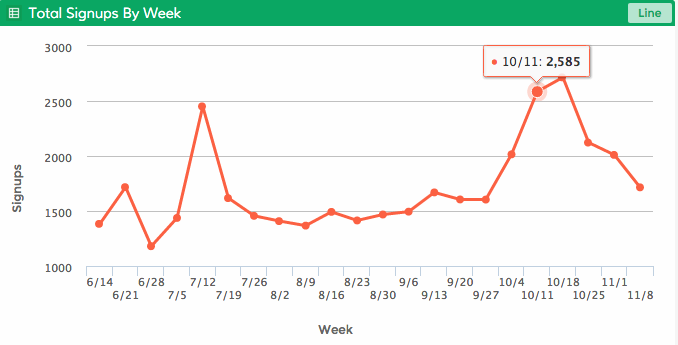
Dasheroo's internal sign up dashboard

Just one of the many KPIs we track at Dasheroo.

A couple weeks ago, I wrote about users vs. customer experience, where I shared my thoughts about the importance of each, and discussed one of the ways we measure customer experience. It’s via a KPI we have called ‘app engagement’.

Well, that’s just one critical juncture in the customer journey, and we measure several KPIs to make sure we’re on the right track.

So the team has been working hard to nail these down, and I thought I’d share them with you. Maybe they can help you establish or rethink yours, or maybe you have an idea or two that you can take away!

Here we go, the following are the Key Performance Indicators for Dasheroo:

  • Signup (SU) = a website signup for a Dasheroo account
  • SU % = # SU/Users to our website and blog (note: we remove any Dasheroo account holders from our Google Analytics ‘User’ value)
  • Connected users = SUs that connected 1+ Insights within 24 hours
  • Connected % = Connected users/SU in that week
  • Engaged users = Connected users that were active in their account in past 7-14-21-30-60 days (note: we measure engagement at multiple timeframes and also have cohort reports to pinpoint any big drop off points and to correlate activity with product releases)
  • Engaged % = # Engaged users/# Connected users in past 60 days
  • Disengaged users = Connected users not active in their account in 60 days
  • Disengaged (or Free Churn) rate = # disengaged within 60 days / #of total connected at beginning of the that 60 day period (this could also be referred to as our ‘Freemium Churn’ rate; how many people did not see the value of our offering)
  • FTC = # first time customers
  • Average Revenue Per User (ARPU)= Monthly revenue/Total paid customers
  • Monthly Recurring Revenue (MRR) = All paying customers * ARPU
  • Churn = # Paid cancels in month
  • Churn rate = Paid churn/total paying customers at the beginning of that month (note: you want to make sure not to include any new FTCs in that month)

Whew! Sure that’s a lot to measure but we feel, at least for now, that these accurately capture and gauge our performance in driving our users through the ‘conversion funnel’ from initial account signup to the holy grail: a paying customer.

And of course now we are developing custom insights for all of these to be shown and continually updated in our business dashboards.

How do you measure your business performance – have you established KPIs that help you identify where your strengths and weaknesses? Let me know!

Startup Lessons Learned: Harmony Sucks!

let's settle this like adultsOK, sure – harmony can definitely be a great thing. But I thought ‘harmony sucks’ might get your attention! And I do believe that harmony sometimes really can suck: it can suck your ability to confront potentially thorny, uncomfortable issues with your team, partners and investors. Which in turn sucks the productivity out of your business.

The Heat is On!

Several years ago, this really hit home for me. The software company I ran a large division of had just acquired another software company of 100 or so people in Iowa and I took over running it. One of the first meetings we had when I landed in Cedar Rapids was attending their exec ops meeting. I really didn’t know what to expect, so let them know I mainly wanted to watch and listen to a typical meeting, and begin to participate after a meeting or two.

I’d never been in a meeting where there was so much heated debate! It even made me a little uncomfortable. People were fighting for their own P&Ls. Making the case for (always) limited resources to be directed to their cause. And they immediately drew me in for my perspective, which I provided by explaining how their goals flowed into the new parent company. And we had some great back and forth on my views too, which we all benefited from.

At the end of this 2-hour meeting, even though everyone didn’t get their own way, the team came away with a clear understanding and respect of ‘why’ the decisions were made, and everyone bought off and got behind getting those actions done. Later, I asked the controller JoAnn if that was a common exec ops meeting, and she assured me that ‘yes’, they approach each of those meetings very seriously, but with mutual respect and always a clear understanding of the tactics and strategy that maximizes the vale of the business. And sometimes it gets heated, and sometimes it doesn’t.

I’ve tried to apply that way of thinking and acting since then.

The Board is Not Bored

We have the best investors I’ve ever been involved with, and the sharpest board as well – board members and advisors alike. At a recent board meeting, we had our most ‘spirited’ meeting yet. Yeah, it even got a little contentious around our discussions on product and my approach to target markets. And you know what? It was our most productive board meeting yet! We all have passion, and that passion came through in very candid discussions around maximizing the value of Dasheroo. We came away with a clear understanding of each other’s views and an action plan we all could get behind and execute on. And most importantly, we all showed the respect we have for each other.

It reminded me that I need to apply ‘non harmony’ not to just our exec ops meetings more often, but in our daily work routine as well; sometimes everyone would rather just ‘get along’ and not surface an issue that may lead to conflict rather than dive into and resolve the thorny issues that are bound to arise in any company.

Question the Boss, They Don’t Know it All

I used to consult for a public company that was stuck in the passive harmony state. I quickly decided to leave, as no one wanted to stand up for what they believed was the in the best interests of their customers. They’d just all do what ‘the boss’ said, and go about their day, never achieving things that they felt were important. It was like living a Dilbert cartoon! Yup, it can infect big ‘ol companies too, probably more often than scrappy ‘lil ones like Dasheroo.

Startup Lesson Learned

It’s easy to go with the flow, and maybe not confront an issue that is really important to you because it might ruffle feathers. You may have to go the extra mile to defend your position, it may not be popular, and you could even lose your argument. Whatever. Get over it. If it’s in the best interest of adding value to your customers and your business, stand up for what you think is important. But also, know where to draw the line, and pick your fights wisely. Too much conflict can also destroy your team’s passion and productivity. And always: show respect.

John@Dasheroo
Co-founder

Startup Lessons: What’s a Good KPI, Users or User Experience?

Dilbert CartoonWe were recently at the awesome LAUNCH Scale event here in SF, and there were dozens of really excellent sessions and speakers. There was a fair amount of talk around the topic of ‘user growth or user experience?’ as a focus point for many SaaS businesses.

The main takeaway IMO is to focus on the user experience. Build a great app and overall experience, and people will sign up.

I mean, what’s the use of driving a bunch of new users if they get a crappy experience? They’ll most likely churn out, and even worse may tell others that they think you suck. But when you create a great user experience, those folks stick around, buy from you, and tell others that they should too. Makes sense!

But what is ‘user experience’, meaning how do you define it? Because if you can’t define it, you can’t measure it. And if you can’t measure it, you can’t impact the performance of it!

Here at Dasheroo, we’re obsessed with creating a fantastic user experience. For our young company, we already have a VP of Customer Success and a Manager of Customer Success. And we’re obsessed with key performance indicators. We actually have several KPIs that we’ve established for our business freemium dashboards company that help gauge user experience.

The one I’m going to discuss here is appropriately called our ‘Engagement Rate’.

Bottom line is what that means is how active folks are within our app. If they’re finding value and being active within the app, that’s a big goal for us. Plus, it’s a leading indicator of purchase and viral growth.

We use this KPI as a leading indicator of a user experience. And here’s how we calculate it:

Our calculation for Engagement Rate

  • In our case, ‘Active user’ means someone who has accessed their dashboard in a specified time period
  • ‘Users that connected to an app’ means they actually creating a dashboard in the same specified time period as our Active user count in the numerator.
  • Why’d I show an ‘X’ for the time period? That’s because we look at Engagement Rate on 7-14-21-30 and 60 day intervals.

And we set goals for each time interval, and have cohorts that show our progress.

This type of approach may or may not be relevant to your business. If it is, great. Regardless, the main point is to define it and measure it. Do we look at this KPI in isolation? Never! We also send quarterly Net Promoter Score (NPS) surveys, usage surveys and have several other KPIs ‘upstream’ and ‘downstream’ in the customer journey.

We always want to improve our user experience and engagement, and are currently working on features and functionality that will hopefully drive that rate higher.

How do you measure user experience? Let me know!

Oh yeah, don’t get me wrong. We LOVE users, but with a great experience, those users will be quality ones.

Plus, watch for an upcoming post where I’ll discuss more of our customer journey KPIs.

Startup Lessons Learned: The Mind Meld

Vulcan Mind MeldHere at Dasheroo we’re a distributed team as I have discussed. We love the ‘structure’ but it does pose challenges, particularly in communications. Sure, we use Slack, Zoom, Basecamp and other collaboration and comms tools and have regular all-hands and 1:1 meetings but is anything lost by not having those spontaneous ‘over the cube’ discussions?

I’m not sure! But it’s certainly something we need to always be mindful of.

But every few months I make sure we have what I call a ‘Mind Meld’. Not a Vulcan Mind Meld where touch technique allows a Vulcan to merge his or her mind with the essence of another’s mind purely by using specialized contact fingertip-points-in a humanoid, usually around the targeted partner’s skull temples. It’s where we bring our ideas together and come out with a futuristic roadmap silly!

So it’s our quarterly planning session. The 5 of us co-founders get together and discuss what we’ve learned and how that should direct our activities going forward. After, we share our thoughts with the team to get their feedback and roll that into our future operational plan.

It’s a time we can assure that we all get together, roll up our sleeves, look each other in the eyes, park our egos at the door and tackle some important issues, including:

  • Are we innovating fast enough?
  • Are we acting like a lean, scrappy start-up (in the good ways)?
  • Are we developing the right features?
  • Are we growing fast enough?
  • Where are we f’ing up, and how are we gonna fix it?
  • What external things have impacted our biz since the last Mind Meld?
  • Are we gonna be able to raise more money?
  • Do we have what it takes to be a global leader in the business dashboard market, and what will that take? And, are we all still on board?

It’s a super productive full-day meeting, and then we go eat and drink like pigs and have some laughs.

We always hold ourselves accountable for our individual KPIs and progress made on the decisions from prior Mind Melds as well.

I’m really excited about our upcoming one in Austin later this month. We’ll be at the point, approximately 6 months post launch, where we have enough empirical data to help show us where our initial assumptions are hitting and missing. Plus we’ve talked to tons of users and potential users & partners to consider their suggestions as well. This is a fun, exciting, challenging and nerve-racking time for sure.

Because of that I already sense some really big things coming out of this one. Fundamental changes that I believe will position us to be a leader in our space; and I’ll talk about them in a post as soon as we’re all in agreement. Then, it’s all about executing and continuing to evolve based on measuring our successes and failures!

What’s your approach to check-ins on your business strategy, execution and overall KPIs? I’m always looking for new ideas!

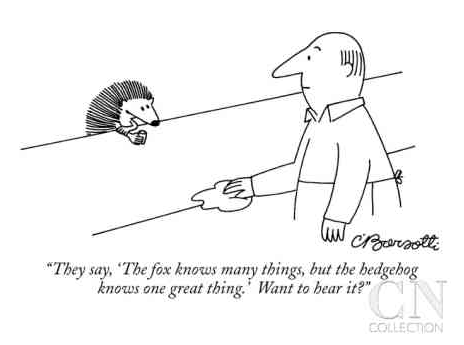
Startup Lessons Learned: Are You a Hedgehog or Fox?

Conde Nast Cartoon

Image: Conde Nast

I love to read, but rarely get a chance to these days to do much more than scan Crunchbase, Mashable and a news feed or two. But a short while ago I got the rare opportunity on a long flight to read a book! And of all the reads I could have chosen, elected Nate Silver’s The Signal & The Noise – Why So Many Predictions Fail.

I chose that one because Nate had always intrigued me – from his ability to predict political election winners to what college baseball player would turn into a great pro. Plus I’m a geek for statistics and probability, it’s why I started Dasheroo.

There’s plenty of great material in the book, including solid reasoning of how the 2008 financial meltdown could have been avoided as well as predicting weather patterns. I enjoyed it all, but what stuck with me the most was the bifurcation of personalities into a ‘hedgehog or fox’.

I wasn’t aware until I did a little more research that this had been written about in the 1950’s by Isaiah Berlin, who cribbed it from Leo Tolstoy and Greek poetry. Silver explains that there are two main types of prognosticators: the hedgehog and the fox and reiterates Greek poet Archilochus’s musing “a fox knows many things, but a hedgehog one important thing.”

What does that mean? To me, it means that foxes tend to be self-critical, eclectic thinkers that consider many solutions and are willing to update their opinions when faced with new information or contrary evidence. Hedgehogs, on the other hand are more likely to have one big concept, idea or belief that they get behind like with pit bull tenacity. They’re typically articulate and very persuasive (sometimes bullying) as to why their idea is correct. For instance, the media often love hedgehogs as they make for great TV.

This principle resonated with me. After thinking about it, I started to categorize folks in one or the other bucket. Personally, I’ve found that I tend to gravitate more toward the fox persona, but I do appreciate the hedgehog mentality as well. There’s certainly a distinct clarity, drive and focus with the hedgehog that can be absent with the fox.

So who’s the better leader, a fox or a hedgehog? Bottom line, I think it’s valuable to build a team that respects each of these personalities – I think foxes need some hedgehog support and vice versa. And the type and stage of company is also important – I’d argue that foxes can make better leaders in early stage companies and start-ups, while hedgehogs take the upper hand in more structured businesses. Even so, I certainly wouldn’t be comfortable with a senior team made up of just foxes or only hedgehogs!

So which are you, and who do you think makes the best leader?

I’ll be writing an additional post or two about how to deal with each of these personas, but in the meantime let me know your thoughts – is it accurate to portray people as one or the other? What’s your experience? Let me know on this Startup Lessons Learned!

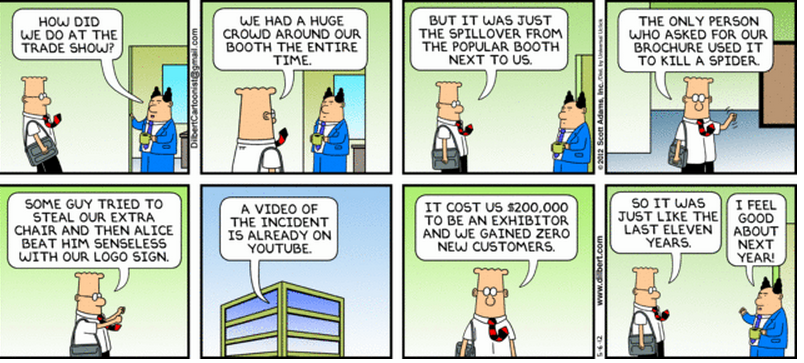
Startup Lessons – How We Chose To Spend on An Expensive Event

In caDilbert for Dasheroo's tracking a KPI for an expensive event.se you didn’t hear, we’re knee deep with Salesforce. We spent resources developing a Lightning Component in time for the
annual “Biggest Event of All Time vs. Oracle”, aka Dreamforce ’15. Some of us thought the decision to go ‘all in’ with Salesforce and prioritize developing a Lightning Component a ‘pivot’, you can also call it just plain being fluid.

Anyhoo, I wrote a different post about that, read it here. Nuff said.

So, we spent precious and finite dev & product resources to build a Lightning Component. What does that mean? It means you’ll be able to view any Key Performance Indicator (KPI) in your Dasheroo business dashboard right within the Salesforce.com application, cool huh?

Our friends at Salesforce were impressed with what our team, and especially Alex, developed in a very short amount of time! And I must say, so was I. SFDC was so happy, they invited Josh and I to speak about it at Dreamforce.

So, the next logical decision was: “hell, should we sponsor as well?”, meaning, should we have a booth at the event. It’s a $25,000 investment for a tiny pod alone, not to mention the cost for a rotating crew of 2-3 Dasheroo folks to staff the pod for 4 days.

Exhibiting at events can be very expensive, and I get pretty frugal when that decision comes around. We’ve only exhibited at one other event, the Market New York Expo last May. And that was less than $5,000 for a full 10′ x 10′ booth for 3 days.

So what were the factors I used to make a decision in this case?

  • Q: Do we want to be 1/2 in or go all the way?
    A: We already made a significant investment in product and engineering, so it seemed like a reasonable investment to go ‘all in’ to hopefully build on our relationship and get Salesforce behind us and our Lightning Component. It worked well for us back in the early days at VerticalResponse when we integrated and got listed on the AppExchange and became the most downloaded application at the time.
  • Q: How close of a match is our market to the Dreamforce attendees?
    A: We knew most DF attendees would be larger businesses than our core SMB target, and we’d be asked to compare ourselves to enterprise offerings like Salesforce Wave, Tableau and Domo. So not a great match, but we really wanted to learn from this type of feedback. And what we confirmed was that Dasheroo is more of a complementary offering to the big guys than a straight-up competitor. Valuable info!
  • Q: Will there be solid feedback and learnings we can use to improve our product development strategy?
    A: If you ask some questions and really listen to the folks that stop by your booth, you should always learn some important things. So Josh (VP Product) and James (VP Engineering) spent a lot of time at the booth and heard challenges and needs first hand. For one, a “BI-light” approach, meaning perhaps we should go one level deeper in uncovering trends or the proverbial ‘canary in the coal mine’.
  • Q: What are the all-in costs (inclusive of travel and lodging)?
    A: Since Dreamforce is in San Francisco, travel and lodging costs were nil. All but one of us that attended lives here. Otherwise, we may have decided to not attend, or may have decided to really trim down the number of us who attended.
  • Q: Will there be partnership opportunities?
    A: I felt we’d get in front of companies that we could have long term growth opportunities with, that we may not get in front of otherwise. And yes, there are a few of those in the hopper!
  • Q: What do we consider an acceptable ‘ROI’?
    A: Contrary to my ROI for most events, I didn’t base this purely on number of leads and estimated sales close rate. That would be a tough calculation to make work, when you have a freemium business dashboard product! I based it on the factors above. Plus, we will measure the ROI on more traditional ‘payback’ approaches. But if we took an estimated $35,000 total investment on the 160 leads we generated, that’s $218 per lead. So we’ll see what happens – maybe we’ll get some larger deals or a couple great partnerships that pay that off. I’ll let you know.

So, yes we attended and 4 of the 5 of us co-founders said ‘yes’ it was worth it. The 5th was on the fence for valid reasons. Now, don’t get me wrong – we have no plans to throw around $25,000 willy nilly, it’s just not in our budget. Plus it hampered our productivity for a full week. But sometimes you have to look past short term traditional ROI to get to a logical decision in these cases when the strategic value can far outweigh the short-term investment.

What’s your take on trade show investment? Let me know!