Startup Lessons Learned: Your Weekly Ops Meeting

Doug Savage business cartoonI’m fortunate, Dasheroo has an awesome team. From the 5 co-founders to the balance of our 12-person squad. For one, we have great chemistry and for the most part have all worked with each other at some point in our careers, so there is a ton of familiarity and respect among us all. Great communication is also key. As a distributed team, we take are heavy users of tools like Slack, Basecamp & Zoom. We have daily stand-ups where we hold a scrum-style ‘activities & blockers’ meeting, 1:1s and each Monday the 5 of us co-founders hold a weekly operations meeting. For this week’s startup lessons I’m focusing on the weekly Ops meeting.

Before we launched, a lot of our Ops meeting focus was around product and development deliverables.

But during a recent 1:1 with Josh, he brought up just this fact: “We all know each other, trust each other, and like each other, but are we really digging into the KPIs and discussing what we need to do to move the business forward?” The answer was…No.

I think we let that ‘familiarity’ aspect of the chemistry between the 5 of us get the best of us. Our ops meetings slowly turned into a ‘how’d the weekend go?’ and took on more of something I hate: an unproductive ‘status meeting’ where we updated a few top line goals and then passed the baton to the next co-founder. Ugh!

Let me remind you – one of the main reasons Dasheroo exists is because, during a stint at another company, I turned one of those ‘status meetings’ into what I renamed the Triple S (Sell Some S*^t!). And what that meant was that everyone in the meeting reported on their main KPIs, how each person’s activities affected the others and overall, how we could work together to make sure what we were focused on really helped drive business success.

So, the new format? KPI driven (what tool do you think we’ll use to report on those?!) with an accountability and group brainstorming perspective.

So here are the key business analytics we now focus on, and they should be obvious:

  • Website sessions and key sources
  • # signups (SU)
  • SU conversion rate
  • % SU who connected an Insight (this is an indicator of activity and engagement)
  • Conversion rate to a paid plan – We’ll expand this into a cohort analysis
  • Churn (we need to define this)
  • Revenue

The result after the first few ‘revamped’ ops meetings? Tremendous. For instance, as Janine was talking about the growth of our SEO and how our keyword targeted landing pages are helping capture mid to long tail traffic, James our VP Engineering noted that we should build a developer-focused landing page. Great! And that’s just one small win.

If this format sounds obvious, maybe you’re ahead of the game. But I challenge everyone reading to take a fresh look at your periodic (our is weekly) ops-style meeting and see if you are digging into and discussing your key performance indicators, and how you as a team can maximize your success.

Startup Lessons Learned: SEO, It’s a Journey Not a Destination

We’ve been plugging away at making our product the best it can be. We want people to love it and tell all of their friends about it so we don’t need to spend a ton of money on Google AdWords – been there, done that. Not at Dasheroo.

This week’s startup lessons learned is all about SEO. We’ve been focusing on our search engine optimization strategy. Janine and Alf have been putting a ton of time into getting above all of the search engine noise. Going up even a point for your Moz page authority and domain authority is NOT easy and takes time. Our focus isn’t just to only win at one big keyword, but to win at dozens of other keywords as well. Only a diversified SEO strategy (ranking high for lots of relevant keyword searches) wins in the long run.

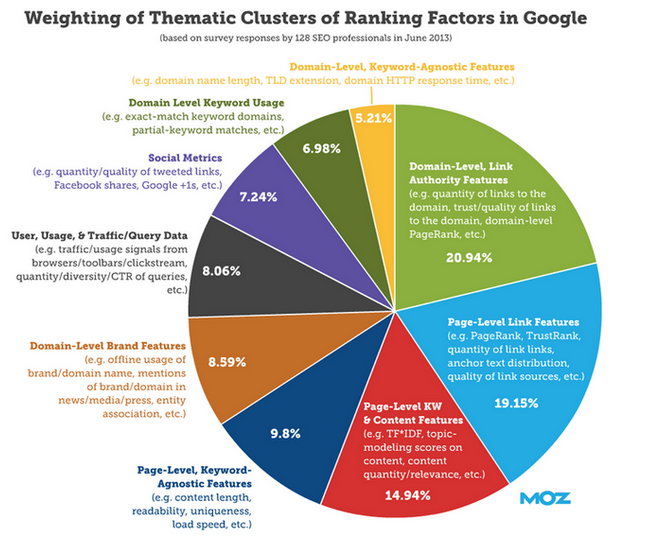
We decided to start with Moz’s pie chart of what goes into Google’s search algorithm. This chart was created by insights from a ton of SEO experts, and focuses on key efforts that are going to really move the needle.

Weighting of Google's ranking factors


1. Inbound Linking – We put a concerted effort into inbound linking since that makes up almost 21% of the ranking factor. And it ain’t like the olden days where you could stick a link on a million sites and get ranked #1. Here it needs to be from quality sites that have a good domain authority. We use the Moz bar when we’re looking at sites and if they’ve got a killer domain authority, they make the list.

2. Page Level Linking – Since this makes up for almost 20% of the ranking factor, we took a look at our website and our blog and found we were not really doing enough linking from page to page and we were just doing one word linking instead of entire phrases. So we changed that. Instead of just linking “Dasheroo” to our blog, we link phrases like best free dashboards a business can find to our site. And we don’t mind linking people off of our site, say to the Moz Bar tool page since it makes total sense for this content you’re reading.

Google description used for Dasheroo's Google Sheets dashboard3. Page Level Keywords & Content – This makes up almost 15% of the Google ranking factor. So we took a look at our site and decided that for every app integration we do, we’re going to make the focus be long-tail keywords. Instead of “business dashboards” all over the site, on these specific pages we may focus on the specific integration. For instance we have an integration with Google Sheets where you can take your Sheets data and create great-looking dashboards. So we have a specific Google Sheets dashboard landing page where the URL reads: https://www.dasheroo.com/google-sheets-dashboard. We put the keyword right in the URL and use the keywords in the description and the content so we hopefully will someday be found pretty easily, we’ve already risen out of nowhere to page 2; page 1 here we come!

SO WHAT HAPPENED AFTER A MONTH OF FOCUS?

Our page authority went up 2 whole points and our domain authority went up 3 (the more important one IMHO). Like the headline says, it’s a journey not a destination. We’ll keep you up to date on how we’re improving and what we’re doing to get there.

Startup Lessons Learned: Have Your Investors & Advisors Work For You

SHave your investors and your advisors working for you!o you raised your financing and brought a couple impressive folks on as advisors or board members. That is awesome! But, it’s more than just money and names – your investors and your advisors are there for you beyond that initial commitment, and they need to be. But not necessarily if you don’t ask, as these are very busy people juggling tons of different priorities. If they’re good, they should be juggling, right?!
We’re very fortunate to have an A-Team supporting us here at our business dashboard startup, Dasheroo. Sharp investors, and seasoned and insightful board members and board advisors. Plus they are all fun as hell to work with! In this Startup Lessons article I want to show you the diversity of our advisors and investors and what they provide depending on what we need at specific times.

Just a sampling of their many contributions over and above their money:

Matt HolleranGeneral Partner, Cloud Apps Capital Partners (Board Member): Cloud Apps is our lead investor, and Matt is our board member, along with me. Matt is the ‘King of Connections’. The ‘Open Sesame’ of strategic business contacts. He seems to knows everyone, and everyone has huge respect for him. When I needed an intro to one of the largest social media publishing platforms, well, he was visiting with the CEO that weekend! Plus he is excellent at helping position our value within the perfect context of each potential partner we discuss. Thay type of value you just can’t buy.

Judy LoehrVenture Partner, Cloud Apps Capital Partners (Board Advisor): Well, where do I start? Judy could be the CMO at damn near any company in the galaxy. So it’s more of a ‘where’ do I ask for input issue. Early on, it was helping establish and vet out our Go-To-Market strategy and pricing approach. Now it’s helping navigate the waters of a very large CRM company we’re beginning a strategic relationship with.

John Jantsch, Founder & CEO Duct Tape Marketing (Advisor): John regularly speaks at social media and marketing conferences around the world. And writes lots of great books. OK, so what does John do for us? He continually provides us with proven, down to earth, practical ideas and feedback. Recently, he advised us on our soon-to-be-released agency pricing (we listened to every word), and we are busy working on ways to have a tight Duct Tape – Dasheroo relationship. We love John because of his never vague, always immediately valuable and pretty easy to implement ideas.

Walter Kortschak, Managing Partner Kortschak Investments (Investor & Advisor): Walter is a large investor and advisor. We’re starting to scale, plus I need advice on the metrics and growth we need to show for a potential B-Round of financing in 2016. Who better to get insight from than a guy like Walter? He was an original investor in MacAfee and helped them achieve super stardom, and has also invested in big-scale companies like Twitter, Evernote and Lyft. So he knows the ins and outs of scaling a successful global business. And again, no ‘pie in the sky’ where it’s not warranted. He has decades of experience and no ego. As we grow, Water will be an even more valuable go-to on building enterprise sales and overall growth of our business.

Maurice Werdegar and Rob Glasser, Western Technology Investments We are honored to count these guys in as an investor in Dasheroo. I liked these guys from the get go; they have a no B.S. attitude and pragmatic approach to helping create successful businesses. We caught up a couple days ago, and they are now going to introduce us to a bunch of their portfolio companies. And if we decide to consider venture debt, they are the highly respected firm in the industry.

Janine Popick, board advisor and Dasheroo CMO. Well, first she grew leading email service provider and SMB darling VerticalResponse into a 1,000,000+ SMB success before she sold it. So she knows a thing or three about the SMB market – how to acquire and retain them. And, I mean this in a good way, lots of ‘in the trenches, here’s what NOT to do’ lessons that only a long-time successful entrepreneur can teach you.

Bottom line: each of these folks has played a huge part in Dasheroo’s growth and we’ve benefitted from quantifiable, measurable value out of them so you need to incorporate them into your business:

  • Have a monthly or quarterly meeting with them with a shortened version of your board deck talking about all of the things you accomplished with one slide: Where You Can Help.
  • Include them on a weekly or monthly progress email so you’re “in their face”. We add all of our investors and advisors on a weekly email called Track Our Startup. Maybe they read it and think “hey, I can help this week.”
  • If you’re coming up on a big decision (like pricing or a legal issue) where one of them has expertise or experience with it, reach out on that specific item.
  • If you need to meet someone very strategic to your business look them up on LinkedIn and see if they’re connected. Then ask for an intro! They can’t read your mind, you have to do the research.

So remember – it’s easy to do all the work to get an investment and advisor team together then go about your business and forget to reach out for help to grow and make their time and money pay back to the largest extent possible. And these people are B-U-S-Y, you cannot expect them to have you top of mind, you have to be the one reaching out.

Now all of that said, we are truly fortunate at Dasheroo in that all the folks I mentioned above DO proactively reach out to help!

Startup Stories: Lessons Learned This Week

This is an exciting week! After several weeks of heads-down development and product work, we’re about ready to release our billing functionality. Maybe that doesn’t sound sexy, but to us it’s where the rubber meets the road…will people pay for Dasheroo? Many have said they will be happy to, so let’s see.

But that’s not the startup lessons learned this week; it’s obvious when you are starting a business that you need to charge for your service. But there’s actually several lessons that this billing project has taught me, and I’m going to focus on a key one now, one that I learned at my last start-up and one that is being reinforced in my experience at Dasheroo.

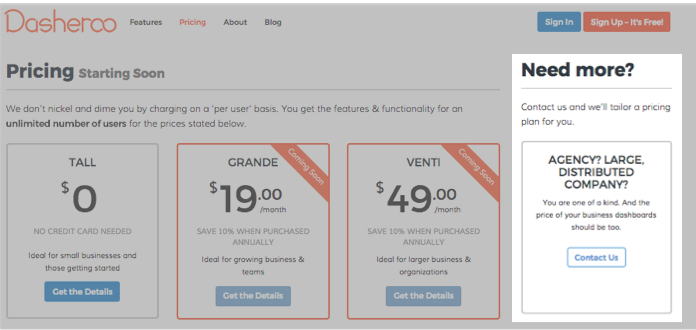
Dasheroo's diversified sales strategy.

At Dasheroo we’re planning on diversifying our sales to different targeted audiences…are you?

And that lesson is that even with an SMB-focused offering, there’s a huge importance of establishing ‘larger company/enterprise’ sales efforts at the get-go. If that seems contradictory, hear me out. Here are my top 3 reasons we’re pursuing this strategy at Dasheroo:

1) Cash flow: In a business freemium model like we have, it takes a lot of $19 per month transactions to make a dent in the cash burn of our business dashboards company. Sure, it’s vital to build what we call the ‘auto-convert’ side of the business and establish our conversion metrics so we can begin modeling out what the business will look like 3-5+ years down the road. But I was reminded of my experience at my last start-up, VerticalResponse, of the value in generating cash NOW.

Similar to Dasheroo, VerticalResponse catered to the SMB market, providing a self-service email marketing platform. Most users paid less than $15 per month, and we knew we needed to offset our cash burn faster than those smaller sales could support. So we targeted companies with large email lists – e-commerce companies for example, that were happy to pay us thousands of dollars per month for the great email deliverability and VIP support we’d provide.

2) Diversification: Although the global small-midsize business market is well diversified with tens of millions of companies – we already have users in 100 countries from a gay pride foundation in Montenegro to a beauty school in Indianapolis to a dev shop in Guadalajara. But I’m talking more macro-level diversification from a sales perspective. Larger companies behave differently. They tend to buy on an annual vs. monthly basis. They tend to like ‘per user’ pricing and VIP support. All items that provide value to our larger customers that we are then able to charge a premium for.

3) Long term sustainable growth & value: This is an issue that really surfaces after you have achieved a level of success selling to SMBs. The spigot of early adopters tend to dry up a bit over time, and it becomes increasingly difficult to sustain the high sales growth rates of the early days. And ‘increasing at a decreasing rate’ isn’t something anyone wants to hear.

So have we landed a ‘whale’ yet? Nope, but we’re in advanced discussions with a few that we hope to come to agreements with soon. And it’s not just good for cash flow, it’s great for internal morale and to position Dasheroo for a better chance of providing long term value to our investors, and potential acquirers.

One note – take caution that one ‘whale’ doesn’t pull you out to sea with one-off feature demands that aren’t scalable to the majority of your user base! Happy fishing.

Startup Lessons Learned: Hiring in Another State

OK, this may not be the sexiest post in the Startup Lessons Learned series, but it’s about one of those things that’s so easy to ignore, or in my case, not even think about when bringing on new team members in different U.S. States – registering your business to do business in that state!

I casually mentioned in a recent board meeting (remember that post about productive board meetings?) that we were building our presence in the lovely city of Austin, Texas and my lawyer’s ears perked up. “Are you registered in Texas?” Emma asked. And semi-confidently, I replied that yes, although we are based in San Francisco, the great folks at ZenPayroll had prompted me to fill out some various forms when I was adding my Austin-based folks to payroll (BTW, we love ZenPayroll, it’s super easy to use, very complete and just a very well done & affordable app.) So I thought I was all done. Not so fast, she said.

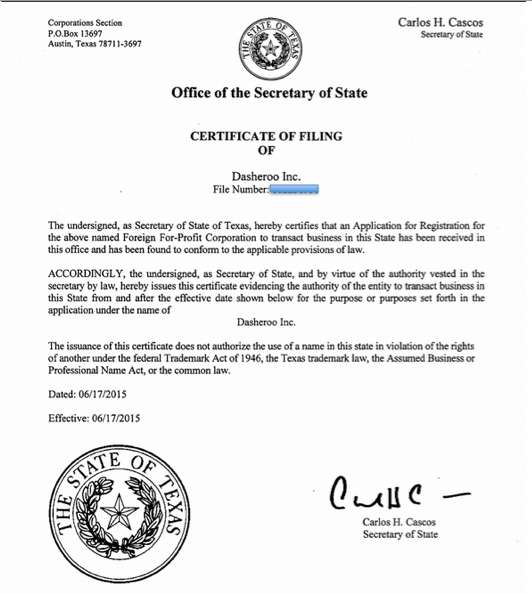
I also had to file a form to be ‘qualified’ to do business in the great state of Texas. It’s an Application for Registration of a For Profit Corporation (the TX Version). It’s an easy form to complete, and just asks for basic info like your business name & address, EIN #, names and addresses of company officers, and the address of the office (even if it’s a home office) in Texas. Oh yeah, plus $750 filing fee. And in about a week, Dasheroo was ‘legit’ to do business in Texas:

Signed, sealed & delivered - we're now legit to do business in Texas

Signed, sealed & delivered – we’re now legit to do business in Texas

We now have our first team member in Georgia. And now I know! Even though ZenPayroll does an awesome job of prompting me with any new payroll-oriented forms to complete, including Department of Revenue (need that payroll tax income!) and Department of Labor forms, there’s still that business registration form that needs to be filed with the Secretary of State.

So especially if you’re building a distributed team for your new business, remember to always check to see if you’re required to register your business in that state. I’m pretty sure every state requires it. It’s more of a housekeeping task than anything else, but take care of it at the get-go, right when you’re adding your next team member in a new state. Plus you’ll avoid potential fines down the road. Who needs that?

Startup Lessons Learned: The Importance of Employee On-boarding

Seems like we’re hiring like crazy lately! Suddenly every one of the co-founders of Dasheroo has at least one direct report. Wow. We are officially up to 13 awesome people – 10 cranking away now, 2 more signed and one ‘secret weapon’ we’ll announce soon!

We’re actually going to hold off on any more new hires, it’s kinda of like letting your food digest after you’ve had a big ‘ol meal. Plus, we need to start generating some $$ to offset our investment in our team.

OK, like I mentioned before we are a distributed work environment, with folks all over the SF Bay Area, Austin and a sprinkling of additional developers in Malaysia & Siberia. So the topic of onboarding our new people is something we feel especially strong about! It’s super key to communicate our story, our competitive benefits, our expectations, our tools and give a feel of our culture. This is even more important as we hire folks outside of our ‘family’, people we don’t have prior work experience with.

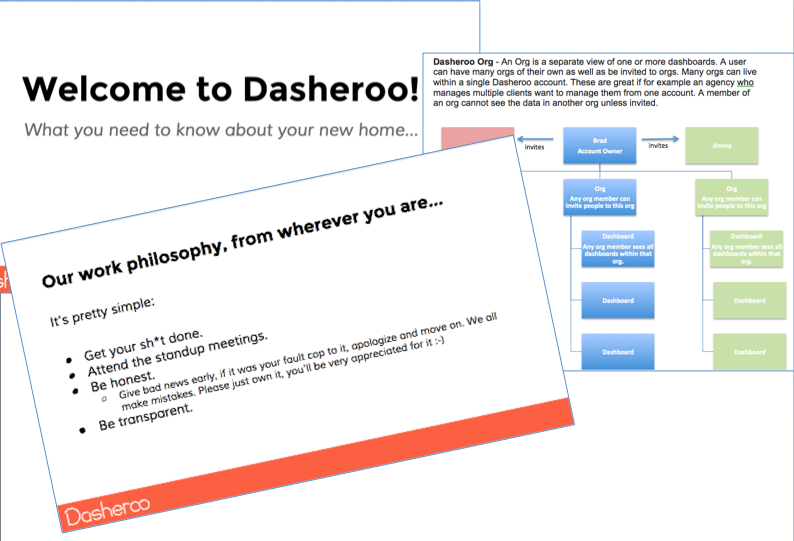
So what’d we do? We developed a couple cool Google docs, that’s what. One is called Onboarding Newbies and the other is simply, Dasheroo Glossary. We really have to work on some jazzier titles for these, but they are chock full of great info, all to get our next A-team Dasherooer up to speed in a flash.

(almost) all the basic info a newbie needs to get up and running fast & efficient at Dasheroo!

(almost) all the basic info a newbie needs to get up and running fast & efficient at Dasheroo!

The glossary includes not just our internal lingo, like ‘what’s an Insight?’ but also industry terminology, like defining what an API (Application Protocol Interface) is and why these are important to our business.

The on-boarding doc includes cool info like our story (why we started Dasheroo), information on each of our team, and our values.

We just shared these docs our Director of Sales, Mimi, who has been here for 3 weeks. She’s already provided info she wished she would have had on her day 1. Awesome!

We’ve also used Screenflow to create videos on how we do things, for instance like email marketing. A) It’s a great help to the new person who needs to learn how we do it and 2) they can refer back to it without continually asking questions.

Speaking of, I need to work on a Screenflow to record a demo to get folks comfy on how we position our product. That’s coming soon, as I’m sure lots of other helpful stuff as we get feedback from our newbies.

Now I wish we would have done this a couple months ago so all new folks could have had it, but hey it’s better to start it at Employee #10 than never!

What are your plans or policies for employee on-boarding? Let me know!