
Surveys can be tricky, and it’s not because of the software we use, products like Survey Monkey make creating and sending surveys easy as pie! The hard part is putting real thought into what you want to get out of the survey and what behaviors you want to change as a result. Here’s how to create the perfect survey.
Know Your Objectives
Before you start writing questions for your survey you need to figure out what you want out of it. Do you want to know how your customers feel about you? Do you need to understand the makeup of your customer list? Keep to the objective, if you start asking questions that are disjointed with the objective “just because” you might run the risk of turning your survey takers “off”.
Tell Everyone What You Want The Data For
It’s a good idea to tell the responders why you’re asking for this data and what you’ll be doing with it. In some cases if you share the findings with your recipients who might find it useful you might get more people taking the survey. If what you’re getting out of it will help your responders let them know in advance!
Questions
Don’t ask leading questions, keep as unbiased as you can! You can have open ended questions in your survey or closed-ended, it depends on what you’re looking for.
Open Ended – These are free form fill in answers. They are harder to “bucket” but can give you some real inside information about your questions. You’ll have to take more time reading them, but you could get some insights into things you may not have thought of. You also run the risk of your survey respondent not having enough time to fill in the big blank.
Closed Ended – These questions will help you evaluate your responses FAST. The trick is you have to know all possible responses you can think of when you include them in a drop down or checkbox format. Consider an “other” with a fill in in the event you missed something. These can be in the form of ranking, rating, radio buttons, checkboxes, etc.
Test It!
You’ve got to send the survey to yourself but also to your teammates to ensure that things look right, the questions make sense and it works!
Analyze
Fun! You’re only doing this survey so you can make the decisions you came up with when you thought about your objectives. If you asked your customers how old they are, you might want to view your answers by age range to see if there are any anomalies. If you asked for geographic location you might see if there are differences in answers by zip code.
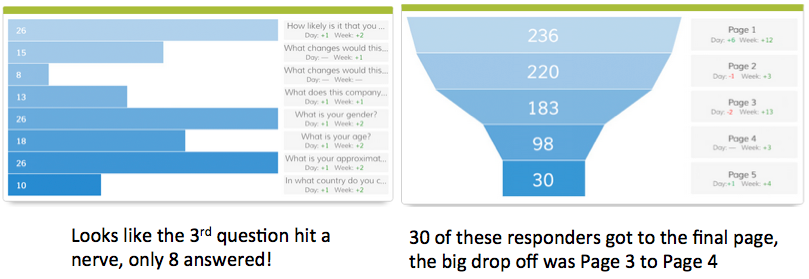
You’ll also want to assess where your responders dropped off the survey if there were multiple pages or which question they hit and stopped. In the example above this company might check out what’s going on between page 3 of the survey to page 4, they may be asking too many questions and turning responders off.
You also want to get enough responses to be statistically valid so if you don’t get enough responses on the first try, consider sending your email with the survey link to those who didn’t respond the first time. They may have just missed it in their inbox, happy surveying!