How To Track a Conversion Funnel

It doesn’t matter what business you’re in, whether you sell to consumers or you sell to businesses, whether it’s a product or a service, you should be looking at your conversion funnels.

A funnel chart starts at 100% and decrements at specific stages of the path that someone takes to consider you in their purchase decision.

So let’s look at a simple example from website visit to a sale:Screen Shot 2014-10-25 at 7.01.07 AM
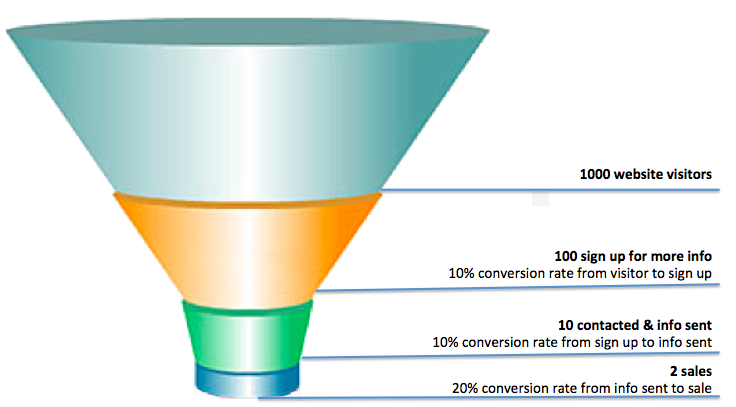
You got 1000 visitors to you site. You know that because you’ve set up Google Analytics to look at that.

When they get to your site they are presented with a bunch of information about your products. 100 of them are somewhat interested so they click and submit their information for more info. That’s a 10% conversion rate from visitor to sign up.

You send them more info and you call them. You get in touch with 10 of them. That’s a 10% conversion rate from sign up to contact.

After the first contact you sell to 2 of them. That’s a 20% conversion rate from contact to close.

If your revenue from those sales covers the cost and time it took to close, great for you. If it doesn’t now is the time to start testing different parts of the funnel!

Hey, we just released Leads by Status and Opportunities by Stage Funnels for Salesforce. Check them out, it’s free!

Website Conversion Rate Benchmarks: Which Metric Should You Use?

First, we hope you are measuring your website conversion rate. Whether you’re an ecommerce biz selling dog toys or a big ‘ol enterprise software company driving leads for your salespeople, conversion rate is a barometer of success.

Now, there is actually a raging debate about whether to use Users (previously Unique Visits in Google Analytics) or Sessions (previously Total Visits). Of course if you use Users as the denominator your conversion rate will be higher, but that’s not a reason to select it over Sessions.

A couple arguments to use Sessions:

  • Every visit is an opportunity to convert!
  • Sessions are more accurate than users. As people do clear cookies, and you have to determine and stick with your timeframe for what a ‘unique’ is. Plus, as the same person will hit your site from different devices, the concept of a ‘unique’/User falls apart.

An argument to use Users:

  • It’s a solid representation of a considered purchase. We’d all like to close the sale on a person’s first visit, but it just doesn’t typically happen. So Users takes that into consideration.

There’s a couple excellent posts on this debate, each supporting a different method: Supporting ‘Users’ is a post from the blog Occam’s Razor; supporting ‘Sessions’ is a post from Matt Belkin at Adobe.

At Dasheroo, we decided to go with Sessions. We’re seeing a lot of mobile device traffic, which is going to muddy the waters if we use Users. We’re convinced folks are visiting us from multiple devices. And even though we are aware that people may be visiting us a few times prior to signing up, we want to improve our site and experience to get them to sign up with less visits. That would mean we’re doing a better job of our marketing!

Bottom line in our opinion: whichever conversion rate benchmarks you prefer stick with it! Consistency in measurement is the main goal here!