Startup Lessons Learned: Your Weekly Ops Meeting

Doug Savage business cartoonI’m fortunate, Dasheroo has an awesome team. From the 5 co-founders to the balance of our 12-person squad. For one, we have great chemistry and for the most part have all worked with each other at some point in our careers, so there is a ton of familiarity and respect among us all. Great communication is also key. As a distributed team, we take are heavy users of tools like Slack, Basecamp & Zoom. We have daily stand-ups where we hold a scrum-style ‘activities & blockers’ meeting, 1:1s and each Monday the 5 of us co-founders hold a weekly operations meeting. For this week’s startup lessons I’m focusing on the weekly Ops meeting.

Before we launched, a lot of our Ops meeting focus was around product and development deliverables.

But during a recent 1:1 with Josh, he brought up just this fact: “We all know each other, trust each other, and like each other, but are we really digging into the KPIs and discussing what we need to do to move the business forward?” The answer was…No.

I think we let that ‘familiarity’ aspect of the chemistry between the 5 of us get the best of us. Our ops meetings slowly turned into a ‘how’d the weekend go?’ and took on more of something I hate: an unproductive ‘status meeting’ where we updated a few top line goals and then passed the baton to the next co-founder. Ugh!

Let me remind you - one of the main reasons Dasheroo exists is because, during a stint at another company, I turned one of those ‘status meetings’ into what I renamed the Triple S (Sell Some S*^t!). And what that meant was that everyone in the meeting reported on their main KPIs, how each person’s activities affected the others and overall, how we could work together to make sure what we were focused on really helped drive business success.

So, the new format? KPI driven (what tool do you think we’ll use to report on those?!) with an accountability and group brainstorming perspective.

So here are the key business analytics we now focus on, and they should be obvious:

  • Website sessions and key sources
  • # signups (SU)
  • SU conversion rate
  • % SU who connected an Insight (this is an indicator of activity and engagement)
  • Conversion rate to a paid plan - We’ll expand this into a cohort analysis
  • Churn (we need to define this)
  • Revenue

The result after the first few ‘revamped’ ops meetings? Tremendous. For instance, as Janine was talking about the growth of our SEO and how our keyword targeted landing pages are helping capture mid to long tail traffic, James our VP Engineering noted that we should build a developer-focused landing page. Great! And that’s just one small win.

If this format sounds obvious, maybe you’re ahead of the game. But I challenge everyone reading to take a fresh look at your periodic (our is weekly) ops-style meeting and see if you are digging into and discussing your key performance indicators, and how you as a team can maximize your success.
Startup Lessons Learned: Establishing & Revising Your Cash Burn Rate

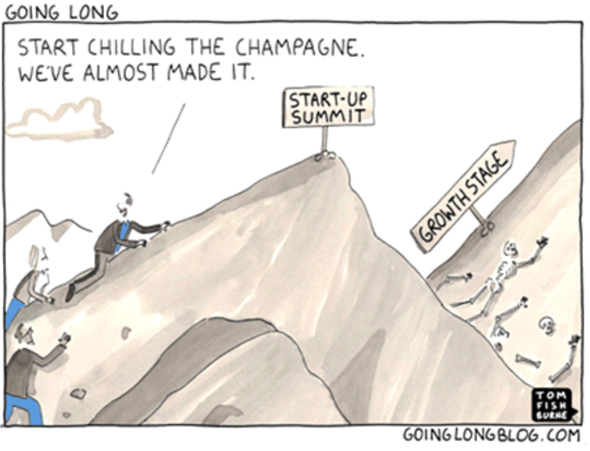
Startup cartoon about startup stage.Whether you raise angel money, seed money or completely blow off taking any outside money for your startup, you need a cost model. A full-on ‘what cash is going out the door?’ model. In my opinion this is way more important at the inception of a startup, than some fancy accrual-based accounting model. Your cash burn rate, and cash management, is king. I may be slightly biased on that approach since I have a finance, not accounting, background but most folks I talk to agree.

You want to go into this process with your eyes wide open on both the cost and revenue side of your early stage business. As good as things may go, new customers and sales may start later or ramp slightly slower than anticipated, and costs are usually the opposite!

One of the first projects I took on after we decided that Dasheroo was ‘a go’ was just this, developing a cost model. I’m not calling it a revenue model because I knew although we would drive some sales early on, it’d be all about investing to establish and grow our team and product offering. Nobody’s going to pay for a 1/2-ass product, at least not for long.

It’s also really important to identify your big costs. There will always be some gotchas that you just didn’t anticipate, like that cool project management software that costs $50 a month. Oh well. As long as you don’t miss a ton of those you should be OK.

So where should you start? First, I think an initial 18-month cost model is a good place to start. Much beyond that is all B.S…I mean, conjecture. And, as detailed as you should be, you should focus on your big ticket items! At Dasheroo, we are leveraging our business freemium model to minimize marketing costs, so the real big expense is people. Our biggest expense categories are:

  • Full time employees
  • Contractors
  • To lesser amounts:
    • Legal & accounting (since we did raise an A round, legal fees were significant)
    • Rent (as we are mainly distributed team, rent is for a small Austin presence)
    • Marketing & Travel and Entertainment (T&E)
    • Amazon Web Services, where we are hosted
    • Software and back-end ops expenses (software like Zendesk, CRM, project management and Amazon Web Services)

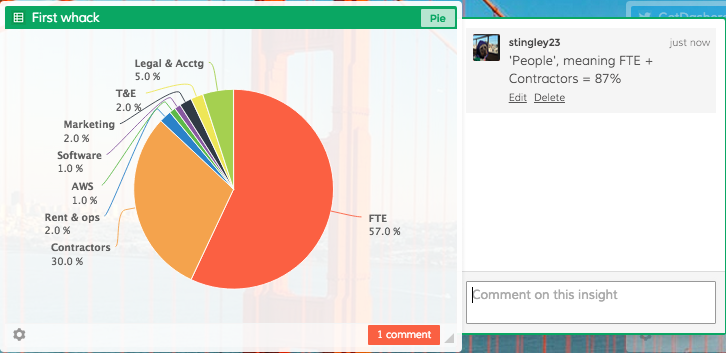
Here was the first whack I took at this in late 2014, for January 2015 out. The actual amounts aren’t so relevant so this shows the distribution of costs across the main areas:

This was my initial cost estimate breakdown for our first 18 months.

This was my initial cost estimate breakdown for our first 18 months.

As you can see, ‘people’ meaning both full time employees and contractors were estimated to make up 87% of our total expenses. That didn’t freak me out, I actually loved it! Great people build awesome things. And especially early on as you are defining and building your product, what else should you be spending on?

This estimate was made before we really had any money to spend, so it was just the best I could do at the time. Note - the total dollar amount also helped guide the amount we needed to raise in our A Round, which was $3.25MM. So, you can do the math!

The model is based on a monthly level of granularity. Other folks do these quarterly, but monthly works best for me. I like measuring on a more frequent basis, and so do my investors.

I then update the burn and input actual expenses each month, and report on variance to forecast to see if there are any big swings I need to take into consideration.

Like I said, things always change, especially when you do have money in the bank. So at least every three months I take a fresh look at what the next months look like. I just did this for the second time, after the initial 6 months of spend. Were there big differences from the original forecast? Let’s see:

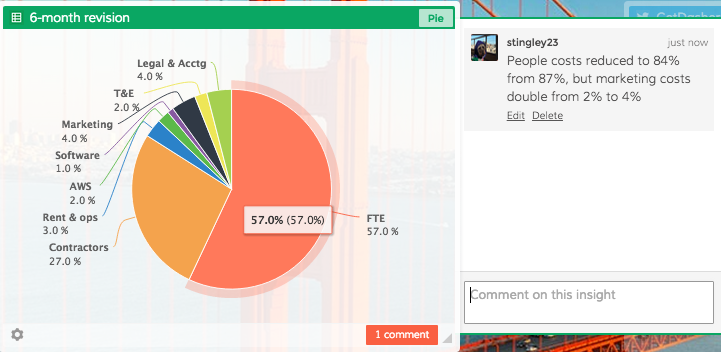
This was a subsequent revision after 6 months of real experience

This was a subsequent revision after 6 months of real experience

Any big differences? Nothing shocking, at least from an ‘expense by category’ perspective. as Not huge, and our % held steady by category. People costs ticked down 3% as we dialed in our main out side contractor, and our marketing share doubled from 2% estimate to 4% of total budget. That’s due to us getting some more detail around key events and trade shows that we plan to exhibit at or attend. We still don’t plan on spending any money on Google Adwords.

Now, if you’ve read this far, you may be asking: “Sure, cost share by category held pretty steady, but how about overall expenses. Did they increase or decrease?”

Great question! Yes they did increase, by approximately 3.5% from original. Now, we are in control of most of this, since our Cost of Goods is very low and the majority of the spend is still in people. So if necessary we could delay a hire or two if we choose to do so.

But, you may have noticed this is pure expense burn before layering in any revenue, which we are already generating, so we’re in great shape.

The bottom line here is that you hope your expense projections do remain in line, but as you gain experience use that to revise projections and make sure you are not spending too far in advance of your model. And make sure to get input from, and share with your team members. Everyone needs to understand the state of the business, and how their actions and performance affects expense and revenue.

Startup Lessons Learned - Considering a Probationary Period Hiring Policy

Should you have a 45 day probationary hiring period?Based on our recent experience having to fire a newly hired employee, it got me thinking…should we establish a probation program for all new hires?


The idea immediately resonated with me. Maybe because it was my idea;) Don’t get me wrong, it’s not an original idea, as a few companies out there do have formal probationary periods prior to hiring.

The program would be similar to what our friends at Buffer do with their Buffer Bootcamp:

  • 45-day probationary period
  • An established plan of what success means during at at the end of the probation period.
  • Meet with a senior team member (in our case, each of the 5 co-founders) for a 1:1 during that time.
  • There would be no benefits granted during this time.
  • And, during the probation period the employee gets paid as a 1099 (consultant).
  • The action at the end of the probation period; either get hired as a FTE or we part ways.

What Are The Pros?

  • It may weed out some folks that know they are ‘talking the talk but can’t walk the walk’, as they say.
  • It could save the time and expense of bringing them onto benefits and payroll.
  • There is no employee-employer relationship, meaning we may lessen the need for any type of severance and of litigation.
  • And most importantly, have more confidence that there is a mutually beneficial business relationship.

What Are The Cons?

  • We could lose some very strong candidates who don’t want to jump through the hoops and leave a full-time job to “maybe” get a job. Or just take another job offer that doesn’t have this hoop.
  • We may be on the hook to pay them for the full 45 days even if they don’t stick around that long.
  • Any more?

After a call with our legal guys and doing some other research, I learned a few things:

  • You really have to look at where your employees reside; there are state-by-state regulations to consider.
  • In CA if they’re doing the job of a full time employee they should be paid as such. Uber is having a huge issue with that ruling. One way around this could be to set the probationary period up as a set ‘project’ with a specific start and end date (the length of your probationary period).
  • A contractor relationship doesn’t guarantee less of a obligation to the worker, nor does it shield you any more from potential litigation. In California, a company like Dasheroo actually has as much, if not more, rights in employer-employee relationships by hiring folks.

So what are we going to do?

It’s always a little murky. Bottom line is we always want to do right by, and respect people. But it’s a two-way street and we take our business very seriously. The difference between hiring an A-player and someone else who may not ‘cut it’ has huge negative affects: the cost of on-boarding, and the lost time you’ll never recover in the productivity you expected.

So, we’re probably going to take a hybrid approach to the situation: continue to hire on a traditional full time employee basis, but start to follow a 45-day plan that mirrors most of Buffer’s probation program. A 45-day on-boarding process with weekly 1:1s with senior team members, a very clear action and progress plan by week, and at the end of the 45 days a meeting with the hiring manager to make sure there’s a mutually beneficial working relationship. Will we go as far as Zappo’s, who we really admire? They actually offer to pay people $2000 to go away after the first few weeks. That practice is ballsy and I love it! But it can also take an HR infrastructure that we, and most other startups don’t have. And it can get costly and abused.

So like I said, it’s a 2-way street, it is incumbent upon our folks to properly vet potential new team members prior to hiring, so many times you can find yourself in a ‘hair on fire’ moment when you just need to fill that gap. Fight that temptation, take a little more time to get to know your potential newest A-player and you’ll win in the end.

Startup Lessons Learned - Cutting The Cord Always Sucks

Donald Trump - The Apprentice

What would The Donald do? Should you do the opposite?!

Let go, dismissed, terminated, sacked, fired. For simplicity, I’m going stick with the tried and true ‘fired’ when it’s ‘that time’ in this post. Plus, ‘terminated’ really seems too personal. This action should not be about personal feelings, it’s all business.

You know it. It’s just not working out with one of your employees. It can happen with folks you’ve worked with for years, but often times it’s with new hires. What are you to do?

As much as the chemistry and talent match may seem to be there during the interview process, you’re just never going to know if there’s a true fit until they’re hired, given goals and measured on them. It’s similar to the disclaimer mutual funds make when touting their above-market returns: “past performance cannot be guaranteed in the future”, meaning as much success as your newbie may have had in the past, no matter how glowing their references are, you never know how they’ll do in the situation you need them for.

And the sooner you catch it, work on it and act on it, the better.

It’s always the same. So often, when you finally fire someone you look back and tell yourself “I wish I would have done this 3 weeks, or 3 months ago”. It’s human nature, I mean unless your employee is downright mean, lazy or dishonest it’s not pleasant to fire someone.

How long do you give it? There’s no hard and fast rule in my book, you have to trust your gut. Often, you and your new employee need at least a few months to see if you get into a good, productive working groove.

But other times, you know more quickly, as in weeks. And in those cases, it’s best to address your concerns in very concrete terms, establish an action plan for rapid improvement and then take action immediately.

Case in point, we recently hired only our second ‘out of network’ team member. By ‘out of network’, I mean outside of the circle of folks we’ve worked with, trust and just ‘know’ over the long haul, as well the people they respect and refer to be part of the team. It’s a great way to build a team, and we prefer that approach whenever possible. But it’s not always possible in certain situations due to timing or plain ‘ol availability. And hey, fresh personalities and experience and perspectives can be a great addition to any growing team.

But in this case, it was clear from the start that there were serious issues and we had to let this person go within 1 month of joining Dasheroo. And it’s never a pleasant experience, although it did reinforce much of what I’d learned in the past.

First, do your part; it’s a 2-way road and the hiring (and firing) process is a significant investment:

Have a good on-boarding process. Provide information that brings your new hire into the fold. This includes information over and above their individual responsibilities, and should include things like the background of the company, why it was founded, what the vision is, and who the founders are. You should also include a glossary of terms that may be specific to your company or industry, and contact information and brief backgrounds of all, or key, team members. At Dasheroo, we created what we think is a great on-boarding package, complete with all the above, plus actual how-to training videos specific to the new hire’s job.

Set clear expectations: The more senior the position, the less point-by-point specific you should have to be regarding exact task deliverables. But for more junior to mid-level hires, set specific, task-level goals that are easy to measure against, like meeting a specific schedule, or the quality of work in a given discipline whether it be coding, writing or speaking to people.

Be honest: There is no room to slip into passive aggressive behavior. If your employee doesn’t know that you are disappointed, or plain pissed off, with their performance it’s your fault. You have a responsibility to address it head on. Be direct and factual, and provide specific examples of the performance or behavior at issue.

Be constructive: Show your employee a path to success. A way to improve, with specific examples of what they need to do in order to meet your expectations. Again, at the most specific level possible. Are they using all the tools available to them? Are they prioritizing their tasks effectively?

Take action! If you have devoted your time to the above actions, and it’s just not working, or looking like it’s not going to work anytime soon, cut the cord and fire that person. Be factual and direct and do not apologize. In my experience this meeting should be no more than 5 minutes and, it really shouldn’t come as a surprise if you have followed the steps above.

My startup lessons learned? It’s a business, not personal decision, and the quicker you take decisive action the better – for your team’s moral & productivity, your respect, and your investors.

What’s your experience and thoughts on this subject? Let me know!

Startup Lessons Learned: Be Fluid & Pivot!

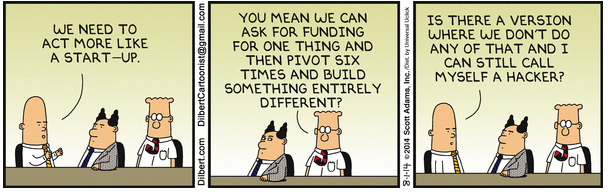
Dilbert Pivot CartoonThese days it’s important to be able to “change course fast” especially if you’re in a nimble startup environment. Don’t get me wrong you need to set your course and nail a roadmap, but if something comes up that’s going to make you grow faster than normal, you need to think about doing it. These onStartup Lessons Learned week I’m focusing on the right way to pivot the team for a big opportunity.

There are a few questions to ask yourself when considering a pivot:

  1. Am I doing this for just one potential customer or will many customer benefit from a pivot
  2. Does it mesh with our strategic plan?
  3. Will it help us grow faster and gain traction?

If you answered yes to all of these good for you, a pivot is likely in order.

At Dasheroo we’ve been marching down a 5 pt. strategic path to get us to where we’d like to be. The plan did call for some partnerships but they don’t happen when you want them to, they don’t happen over night and they usually happen with a lot of luck coupled with your hard work at seeking them out. One such potential partnership is on the horizon so we had to pivot our team and their time and put some development and marketing effort into this partnership earlier than anticipated.

The first thing on your to-do list is to get your team around it. If you’ve got a great team and the pivot makes sense then they’ll follow the strategic marching orders to the end. So I gathered the team and talked to them about it and we went through it together. As a team we wanted to make sure that pivoting for this partnership:

  1. Will benefit this customer or partner and all that come after, and it does. The work that Alex is doing for this partnership on OAuth gets us working with other partners quicker!
  2. Goes along with what we need to do to grow. We don’t want to spend a ton of money on advertising on Google so getting our product distributed through partnerships is what we need to do and this one could be big.
  3. Hopefully gets us to where we want to be faster and better. If this partnership works the way we’d like it to, we could potentially have a nice pop in growth.

It was important for me to include everyone in on the decision since the entire team will be doing a all of the work. And this team fortunately gets it. There’s no guarantee that it will work wonders for us but everyone understands that giving it our best shot is all we can do.Got a potential pivot coming up? Make sure everyone is on the same page! More on this partnership as we launch.

Startup Lessons Learned: SEO, It’s a Journey Not a Destination

We’ve been plugging away at making our product the best it can be. We want people to love it and tell all of their friends about it so we don’t need to spend a ton of money on Google AdWords - been there, done that. Not at Dasheroo.

This week’s startup lessons learned is all about SEO. We’ve been focusing on our search engine optimization strategy. Janine and Alf have been putting a ton of time into getting above all of the search engine noise. Going up even a point for your Moz page authority and domain authority is NOT easy and takes time. Our focus isn’t just to only win at one big keyword, but to win at dozens of other keywords as well. Only a diversified SEO strategy (ranking high for lots of relevant keyword searches) wins in the long run.

We decided to start with Moz’s pie chart of what goes into Google’s search algorithm. This chart was created by insights from a ton of SEO experts, and focuses on key efforts that are going to really move the needle.

Weighting of Google's ranking factors


1. Inbound Linking - We put a concerted effort into inbound linking since that makes up almost 21% of the ranking factor. And it ain’t like the olden days where you could stick a link on a million sites and get ranked #1. Here it needs to be from quality sites that have a good domain authority. We use the Moz bar when we’re looking at sites and if they’ve got a killer domain authority, they make the list.

2. Page Level Linking - Since this makes up for almost 20% of the ranking factor, we took a look at our website and our blog and found we were not really doing enough linking from page to page and we were just doing one word linking instead of entire phrases. So we changed that. Instead of just linking “Dasheroo” to our blog, we link phrases like best free dashboards a business can find to our site. And we don’t mind linking people off of our site, say to the Moz Bar tool page since it makes total sense for this content you’re reading.

Google description used for Dasheroo's Google Sheets dashboard3. Page Level Keywords & Content - This makes up almost 15% of the Google ranking factor. So we took a look at our site and decided that for every app integration we do, we’re going to make the focus be long-tail keywords. Instead of “business dashboards” all over the site, on these specific pages we may focus on the specific integration. For instance we have an integration with Google Sheets where you can take your Sheets data and create great-looking dashboards. So we have a specific Google Sheets dashboard landing page where the URL reads: https://www.dasheroo.com/google-sheets-dashboard. We put the keyword right in the URL and use the keywords in the description and the content so we hopefully will someday be found pretty easily, we’ve already risen out of nowhere to page 2; page 1 here we come!

SO WHAT HAPPENED AFTER A MONTH OF FOCUS?

Our page authority went up 2 whole points and our domain authority went up 3 (the more important one IMHO). Like the headline says, it’s a journey not a destination. We’ll keep you up to date on how we’re improving and what we’re doing to get there.

Startup Lessons Learned: Have Your Investors & Advisors Work For You

SHave your investors and your advisors working for you!o you raised your financing and brought a couple impressive folks on as advisors or board members. That is awesome! But, it’s more than just money and names - your investors and your advisors are there for you beyond that initial commitment, and they need to be. But not necessarily if you don’t ask, as these are very busy people juggling tons of different priorities. If they’re good, they should be juggling, right?!


We’re very fortunate to have an A-Team supporting us here at our business dashboard startup, Dasheroo. Sharp investors, and seasoned and insightful board members and board advisors. Plus they are all fun as hell to work with! In this Startup Lessons article I want to show you the diversity of our advisors and investors and what they provide depending on what we need at specific times.

Just a sampling of their many contributions over and above their money:

Matt Holleran - General Partner, Cloud Apps Capital Partners (Board Member): Cloud Apps is our lead investor, and Matt is our board member, along with me. Matt is the ‘King of Connections’. The ‘Open Sesame’ of strategic business contacts. He seems to knows everyone, and everyone has huge respect for him. When I needed an intro to one of the largest social media publishing platforms, well, he was visiting with the CEO that weekend! Plus he is excellent at helping position our value within the perfect context of each potential partner we discuss. Thay type of value you just can’t buy.

Judy Loehr - Venture Partner, Cloud Apps Capital Partners (Board Advisor): Well, where do I start? Judy could be the CMO at damn near any company in the galaxy. So it’s more of a ‘where’ do I ask for input issue. Early on, it was helping establish and vet out our Go-To-Market strategy and pricing approach. Now it’s helping navigate the waters of a very large CRM company we’re beginning a strategic relationship with.

John Jantsch, Founder & CEO Duct Tape Marketing (Advisor): John regularly speaks at social media and marketing conferences around the world. And writes lots of great books. OK, so what does John do for us? He continually provides us with proven, down to earth, practical ideas and feedback. Recently, he advised us on our soon-to-be-released agency pricing (we listened to every word), and we are busy working on ways to have a tight Duct Tape - Dasheroo relationship. We love John because of his never vague, always immediately valuable and pretty easy to implement ideas.

Walter Kortschak, Managing Partner Kortschak Investments (Investor & Advisor): Walter is a large investor and advisor. We’re starting to scale, plus I need advice on the metrics and growth we need to show for a potential B-Round of financing in 2016. Who better to get insight from than a guy like Walter? He was an original investor in MacAfee and helped them achieve super stardom, and has also invested in big-scale companies like Twitter, Evernote and Lyft. So he knows the ins and outs of scaling a successful global business. And again, no ‘pie in the sky’ where it’s not warranted. He has decades of experience and no ego. As we grow, Water will be an even more valuable go-to on building enterprise sales and overall growth of our business.

Maurice Werdegar and Rob Glasser, Western Technology Investments We are honored to count these guys in as an investor in Dasheroo. I liked these guys from the get go; they have a no B.S. attitude and pragmatic approach to helping create successful businesses. We caught up a couple days ago, and they are now going to introduce us to a bunch of their portfolio companies. And if we decide to consider venture debt, they are the highly respected firm in the industry.

Janine Popick, board advisor and Dasheroo CMO. Well, first she grew leading email service provider and SMB darling VerticalResponse into a 1,000,000+ SMB success before she sold it. So she knows a thing or three about the SMB market - how to acquire and retain them. And, I mean this in a good way, lots of ‘in the trenches, here’s what NOT to do’ lessons that only a long-time successful entrepreneur can teach you.

Bottom line: each of these folks has played a huge part in Dasheroo’s growth and we’ve benefitted from quantifiable, measurable value out of them so you need to incorporate them into your business:

  • Have a monthly or quarterly meeting with them with a shortened version of your board deck talking about all of the things you accomplished with one slide: Where You Can Help.
  • Include them on a weekly or monthly progress email so you’re “in their face”. We add all of our investors and advisors on a weekly email called Track Our Startup. Maybe they read it and think “hey, I can help this week.”
  • If you’re coming up on a big decision (like pricing or a legal issue) where one of them has expertise or experience with it, reach out on that specific item.
  • If you need to meet someone very strategic to your business look them up on LinkedIn and see if they’re connected. Then ask for an intro! They can’t read your mind, you have to do the research.

So remember - it’s easy to do all the work to get an investment and advisor team together then go about your business and forget to reach out for help to grow and make their time and money pay back to the largest extent possible. And these people are B-U-S-Y, you cannot expect them to have you top of mind, you have to be the one reaching out.

Now all of that said, we are truly fortunate at Dasheroo in that all the folks I mentioned above DO proactively reach out to help!

Startup Lessons Learned This Week: The Power of ‘No’

Image for the Dasheroo Power of No article.As I mentioned in Startup Lessons Learned in the past couple weeks, we’ve launched our pricing and our billing solution. So now that we can actually charge people, we’re getting into sales discussions with agencies and larger companies who are interested in our business dashboards solution. It’s exciting!

That said, we just launched Dasheroo on May 5, so we’re still early on and we don’t yet have all the features and functionality that more advanced users like agencies or consultants want. Features like co-branding our app, dashboard exports, and user roles and permissions.

So, just this past week I’ve been in the unenviable position of having to say ‘No’ (more on that below) to several excellent prospects. “Do you have co-branding?”, “Can I export your dashboards to a PowerPoint?”, “Can I make this dashboard read-only?”

‘No’, we don’t have any of those features yet. Years ago I would have freaked out to not have a pocket full of “Yes” to respond with. I would have felt like a loser, and the pressure to close a sale now would have been immense.

But there are benefits of this powerful, and sometimes feared, word. Let’s take a closer look at ‘No’:

  • It shows some real honesty & confidence; people appreciate that.
  • You can sometimes turn a ‘no’ into a thank you, when the request sounds reasonable but you’re just not sure if you’ll ever get around to it. Occasionally we’ll receive feature requests than actually sound great, but not for the near term. So it’s not a ‘no’, it’s a “Thank you for your suggestion. This feature isn’t on our near-term roadmap, but I’ll get it in front of our product folks to review…”. And we do review each feature request we receive.
  • ‘No’ can often be communicated as ‘Not yet or ‘No, but…”, if that is an accurate statement. For instance, co-branding, dashboard exports, and advanced user roles and permissions are in fact on our near-term product roadmap. People will be patient if they believe that your goals are aligned and you’re open with them.
  • Sometimes a firm ‘No’ is warranted. In the case where one customer may be forcing feature demands on you that will not value the balance of your users, or is just something you feel strongly is not in your best interests. Jason Freid of Basecamp wrote a great article a few years ago, where he noted that a customer requested they provide Gantt Charts as part of their Basecamp project management offering. He duly noted that many other companies already provide Gantt Charts and it’s not something they will ever consider.

After several agency and larger company meetings the past week or so, the results are interesting and encouraging. People genuinely like our user interface, ease of use and pricing. That’s the core of our value proposition. So when we discuss upcoming features and functionality with these folks, we’re driving toward a mutually beneficial solution and inviting them to help define that solution. Plus, we’re often able to provide some short term workarounds in the meantime.

So can forms of ‘No’ actually get you to a yes? It’s looking promising, plus it ensures that we stay true to our product vision, which hopefully will benefit all of our users for years to come.

What’s your take on the pros and cons of ‘No’? Let me know!

Startup Lessons Learned This Week: Setting Our Pricing

Last week in Startup Lessons Learned I discussed the importance of establishing sales strategies on both ends of the business spectrum - from a strong ‘auto convert’ for the SMBs all the way up to big ‘ol enterprise types. What that means is this - folks that will pull out their credit card for a $19 purchase when electronically prompted, all the way up to negotiated contracts in the several of thousands of dollars.

So when deciding on your startup pricing strategy, there are so many important items to consider. But I’m going to focus on the 3 biggies we drilled into when setting our initial ‘auto convert’ pricing, as I feel they establish the foundation of a good pricing strategy. Here we go:

1) Your costs. Evaluate both fixed and especially variable costs. For us, the incremental costs of supporting each new user is relatively low. Our incremental costs get down to efficiently scaling the backend server and database costs, being very efficient with API calls to the 3rd party applications we connect to, and customer support. With a business freemium model like we have, incremental variable costs must remain low. For yours? Who knows, but start with your cost basis, and make sure you are very realistic on your costs now, and how they will change over time, especially if you grow.

2) Your competition. You need to be mindful of the competitive environment. Businesses are very cost-sensitive. Does that mean you need to undercut your competition? Not necessarily. First, try to understand your competitor’s pricing approach. What are they basing it on? Is it per user or per ‘widget’? Figure out their pricing metric(s). If you can understand that you can shape your pricing to be a greater value. And that is really what it comes down to, to win the long term race. Value.

Note: Don’t get too crazed by just one competitor’s pricing. You could whip yourself into a frenzy trying to compete with it, and then they change their pricing the next day!

3) Your value. Here’s where your pricing strategy culminates into a successful business. Answering the question “What do users derive the most value from?” You can’t trick, cajole, or hold important stuff hostage, in order to drive long term profitable relationships with your users. And although price points are a huge consideration, if they are not based on ‘value realized’ it won’t matter.

Bottom line, here’s what we did for our SMB auto-convert pricing (I’ll talk agency and larger company pricing in a future post.)

Ou just launched business dashboard pricing

Our just launched business dashboard pricing!

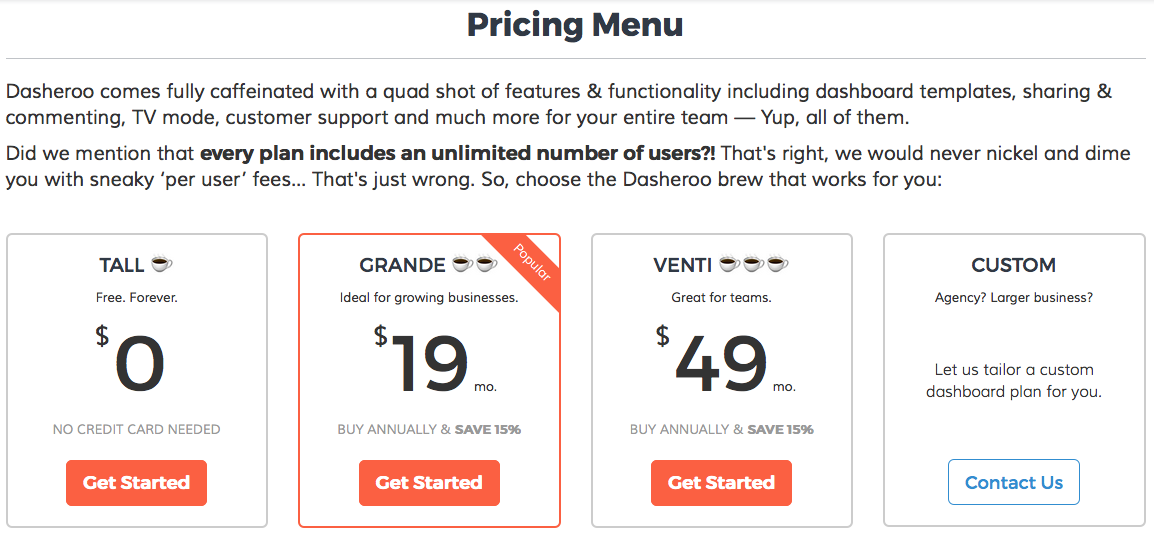
  • Free! We call this our “Tall” pricing tier. We feel business freemium reduces the risk a business takes, and allows for rapid global adoption. Sharp folks like Mailchimp, LinkedIn, Hootsuite and SurveyMonkey have all proven this out. Otherwise, users are forced to make a pay/flee decision after a 14-30 day trial, and often these busy users need a longer period of time to derive value from a product. We felt that leading with a 100% risk-free offer satisfies my three considerations above, provides a huge value, a competitive advantage and fits within our cost structure.
    • We’re big believers in really providing great value in the freemium edition. No stripped down bait-and-switch type stuff. At VerticalResponse (where a lot of us have experience from) we re-tooled the traditional 30-day free trial into a freemium.

Dilbert: Freemium Model Cartoon

  • No ‘per user’ pricing. We really deliberated on this one! Debated. Argued. Hell, I think I argued with myself on this decision! But at the end, we all came to agreement that our pricing should be more like Basecamp’s pricing for project management than Insightly’s per-user pricing for CRM. CRM tools like Insightly naturally lend themselves to a per-user pricing schema, but with business dashboards, you get some users that may casually log in once per month, others that log in daily. So why make people hesitant to invite that casual user?
  • Great conversion price points and clear value triggers. So, the next pricing tiers are Grande and Venti, tipping a hat to Starbucks. You want to achieve a couple things here. First, there are natural price points that tend to drive a conversion. As in our $19 Grande plan. Sure we could have priced at $23 or $16. But we’ve done enough testing in our (long) lives to know that we’ll get as many folks to pay us $19 than $16 (I’ll take an extra $3/month to invest in innovation), and probably drive 30%+ conversions than pricing a couple bucks over the magic $20. Same goes for the Venti pricing. Secondly, our value-add (triggers) are clear. It’s completely usage based. You consume more Insights, we hope it’s clear that you should budget a little more per month for that additional usage, and a couple more bells and whistles.

A guarantee? We’ll most likely change our pricing at some point. As we learn, instrument (we love Mixpanel!) usage, get feedback from our awesome users and add more features and functionality we’ll adjust our prices. But we plan on always treating our current users well, and offer ‘grandfather’ plans to them.

Oh yeah, why the caffienated pricing? It just seemed catchy and fun. Hopefully it’s clear to people, otherwise we may change those labels as well!

Startup Lessons Learned: Hiring in Another State

OK, this may not be the sexiest post in the Startup Lessons Learned series, but it’s about one of those things that’s so easy to ignore, or in my case, not even think about when bringing on new team members in different U.S. States - registering your business to do business in that state!

I casually mentioned in a recent board meeting (remember that post about productive board meetings?) that we were building our presence in the lovely city of Austin, Texas and my lawyer’s ears perked up. “Are you registered in Texas?” Emma asked. And semi-confidently, I replied that yes, although we are based in San Francisco, the great folks at ZenPayroll had prompted me to fill out some various forms when I was adding my Austin-based folks to payroll (BTW, we love ZenPayroll, it’s super easy to use, very complete and just a very well done & affordable app.) So I thought I was all done. Not so fast, she said.

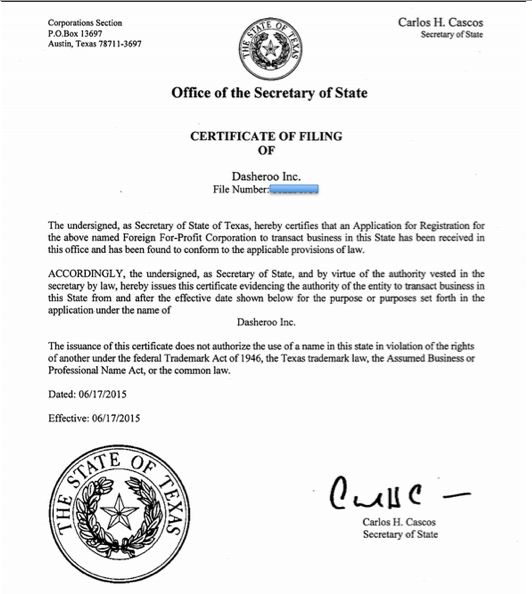
I also had to file a form to be ‘qualified’ to do business in the great state of Texas. It’s an Application for Registration of a For Profit Corporation (the TX Version). It’s an easy form to complete, and just asks for basic info like your business name & address, EIN #, names and addresses of company officers, and the address of the office (even if it’s a home office) in Texas. Oh yeah, plus $750 filing fee. And in about a week, Dasheroo was ‘legit’ to do business in Texas:

Signed, sealed & delivered - we're now legit to do business in Texas

Signed, sealed & delivered - we’re now legit to do business in Texas

We now have our first team member in Georgia. And now I know! Even though ZenPayroll does an awesome job of prompting me with any new payroll-oriented forms to complete, including Department of Revenue (need that payroll tax income!) and Department of Labor forms, there’s still that business registration form that needs to be filed with the Secretary of State.

So especially if you’re building a distributed team for your new business, remember to always check to see if you’re required to register your business in that state. I’m pretty sure every state requires it. It’s more of a housekeeping task than anything else, but take care of it at the get-go, right when you’re adding your next team member in a new state. Plus you’ll avoid potential fines down the road. Who needs that?