
Last week in Startup Lessons Learned I discussed the importance of establishing sales strategies on both ends of the business spectrum - from a strong ‘auto convert’ for the SMBs all the way up to big ‘ol enterprise types. What that means is this - folks that will pull out their credit card for a $19 purchase when electronically prompted, all the way up to negotiated contracts in the several of thousands of dollars.
So when deciding on your startup pricing strategy, there are so many important items to consider. But I’m going to focus on the 3 biggies we drilled into when setting our initial ‘auto convert’ pricing, as I feel they establish the foundation of a good pricing strategy. Here we go:
1) Your costs. Evaluate both fixed and especially variable costs. For us, the incremental costs of supporting each new user is relatively low. Our incremental costs get down to efficiently scaling the backend server and database costs, being very efficient with API calls to the 3rd party applications we connect to, and customer support. With a business freemium model like we have, incremental variable costs must remain low. For yours? Who knows, but start with your cost basis, and make sure you are very realistic on your costs now, and how they will change over time, especially if you grow.
2) Your competition. You need to be mindful of the competitive environment. Businesses are very cost-sensitive. Does that mean you need to undercut your competition? Not necessarily. First, try to understand your competitor’s pricing approach. What are they basing it on? Is it per user or per ‘widget’? Figure out their pricing metric(s). If you can understand that you can shape your pricing to be a greater value. And that is really what it comes down to, to win the long term race. Value.
Note: Don’t get too crazed by just one competitor’s pricing. You could whip yourself into a frenzy trying to compete with it, and then they change their pricing the next day!
3) Your value. Here’s where your pricing strategy culminates into a successful business. Answering the question “What do users derive the most value from?” You can’t trick, cajole, or hold important stuff hostage, in order to drive long term profitable relationships with your users. And although price points are a huge consideration, if they are not based on ‘value realized’ it won’t matter.
Bottom line, here’s what we did for our SMB auto-convert pricing (I’ll talk agency and larger company pricing in a future post.)
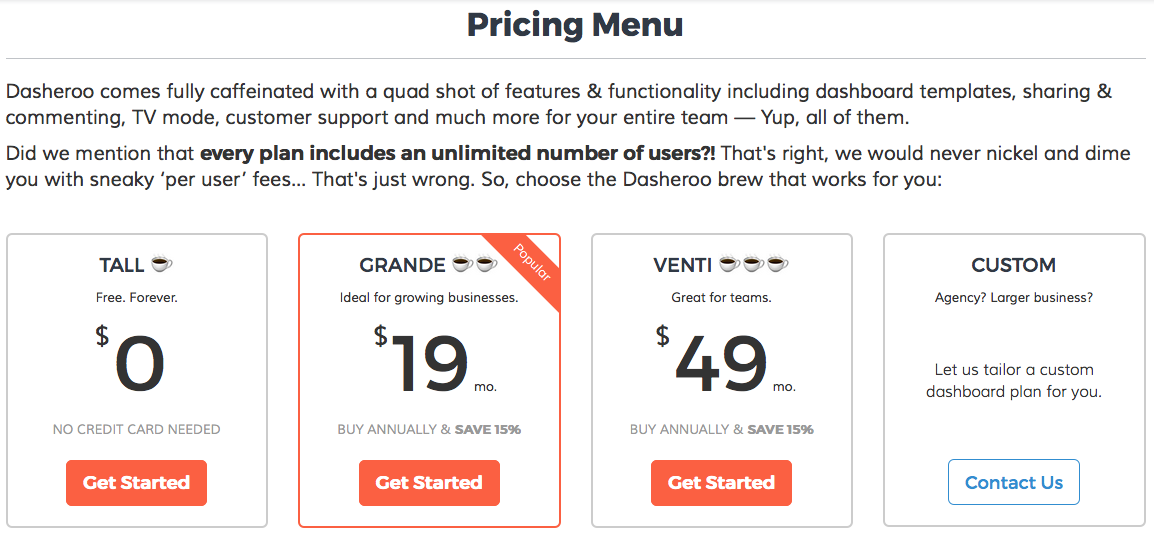
Our just launched business dashboard pricing!
- Free! We call this our “Tall” pricing tier. We feel business freemium reduces the risk a business takes, and allows for rapid global adoption. Sharp folks like Mailchimp, LinkedIn, Hootsuite and SurveyMonkey have all proven this out. Otherwise, users are forced to make a pay/flee decision after a 14-30 day trial, and often these busy users need a longer period of time to derive value from a product. We felt that leading with a 100% risk-free offer satisfies my three considerations above, provides a huge value, a competitive advantage and fits within our cost structure.
- We’re big believers in really providing great value in the freemium edition. No stripped down bait-and-switch type stuff. At VerticalResponse (where a lot of us have experience from) we re-tooled the traditional 30-day free trial into a freemium.
- No ‘per user’ pricing. We really deliberated on this one! Debated. Argued. Hell, I think I argued with myself on this decision! But at the end, we all came to agreement that our pricing should be more like Basecamp’s pricing for project management than Insightly’s per-user pricing for CRM. CRM tools like Insightly naturally lend themselves to a per-user pricing schema, but with business dashboards, you get some users that may casually log in once per month, others that log in daily. So why make people hesitant to invite that casual user?
- Great conversion price points and clear value triggers. So, the next pricing tiers are Grande and Venti, tipping a hat to Starbucks. You want to achieve a couple things here. First, there are natural price points that tend to drive a conversion. As in our $19 Grande plan. Sure we could have priced at $23 or $16. But we’ve done enough testing in our (long) lives to know that we’ll get as many folks to pay us $19 than $16 (I’ll take an extra $3/month to invest in innovation), and probably drive 30%+ conversions than pricing a couple bucks over the magic $20. Same goes for the Venti pricing. Secondly, our value-add (triggers) are clear. It’s completely usage based. You consume more Insights, we hope it’s clear that you should budget a little more per month for that additional usage, and a couple more bells and whistles.
A guarantee? We’ll most likely change our pricing at some point. As we learn, instrument (we love Mixpanel!) usage, get feedback from our awesome users and add more features and functionality we’ll adjust our prices. But we plan on always treating our current users well, and offer ‘grandfather’ plans to them.
Oh yeah, why the caffienated pricing? It just seemed catchy and fun. Hopefully it’s clear to people, otherwise we may change those labels as well!