Startup Lessons - How We Chose To Spend on An Expensive Event

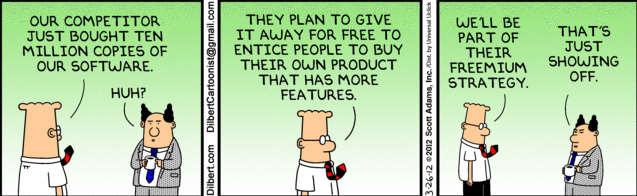
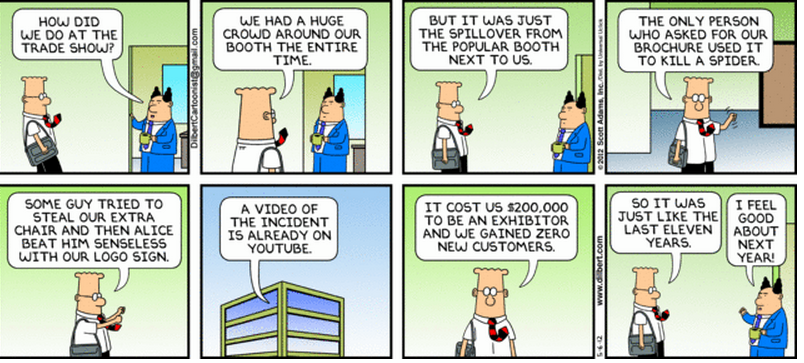
In caDilbert for Dasheroo's tracking a KPI for an expensive event.se you didn’t hear, we’re knee deep with Salesforce. We spent resources developing a Lightning Component in time for the
annual “Biggest Event of All Time vs. Oracle”, aka Dreamforce ’15. Some of us thought the decision to go ‘all in’ with Salesforce and prioritize developing a Lightning Component a ‘pivot’, you can also call it just plain being fluid.

Anyhoo, I wrote a different post about that, read it here. Nuff said.

So, we spent precious and finite dev & product resources to build a Lightning Component. What does that mean? It means you’ll be able to view any Key Performance Indicator (KPI) in your Dasheroo business dashboard right within the Salesforce.com application, cool huh?

Our friends at Salesforce were impressed with what our team, and especially Alex, developed in a very short amount of time! And I must say, so was I. SFDC was so happy, they invited Josh and I to speak about it at Dreamforce.

So, the next logical decision was: “hell, should we sponsor as well?”, meaning, should we have a booth at the event. It’s a $25,000 investment for a tiny pod alone, not to mention the cost for a rotating crew of 2-3 Dasheroo folks to staff the pod for 4 days.

Exhibiting at events can be very expensive, and I get pretty frugal when that decision comes around. We’ve only exhibited at one other event, the Market New York Expo last May. And that was less than $5,000 for a full 10′ x 10′ booth for 3 days.

So what were the factors I used to make a decision in this case?

  • Q: Do we want to be 1/2 in or go all the way?
    A: We already made a significant investment in product and engineering, so it seemed like a reasonable investment to go ‘all in’ to hopefully build on our relationship and get Salesforce behind us and our Lightning Component. It worked well for us back in the early days at VerticalResponse when we integrated and got listed on the AppExchange and became the most downloaded application at the time.
  • Q: How close of a match is our market to the Dreamforce attendees?
    A: We knew most DF attendees would be larger businesses than our core SMB target, and we’d be asked to compare ourselves to enterprise offerings like Salesforce Wave, Tableau and Domo. So not a great match, but we really wanted to learn from this type of feedback. And what we confirmed was that Dasheroo is more of a complementary offering to the big guys than a straight-up competitor. Valuable info!
  • Q: Will there be solid feedback and learnings we can use to improve our product development strategy?
    A: If you ask some questions and really listen to the folks that stop by your booth, you should always learn some important things. So Josh (VP Product) and James (VP Engineering) spent a lot of time at the booth and heard challenges and needs first hand. For one, a “BI-light” approach, meaning perhaps we should go one level deeper in uncovering trends or the proverbial ‘canary in the coal mine’.
  • Q: What are the all-in costs (inclusive of travel and lodging)?
    A: Since Dreamforce is in San Francisco, travel and lodging costs were nil. All but one of us that attended lives here. Otherwise, we may have decided to not attend, or may have decided to really trim down the number of us who attended.
  • Q: Will there be partnership opportunities?
    A: I felt we’d get in front of companies that we could have long term growth opportunities with, that we may not get in front of otherwise. And yes, there are a few of those in the hopper!
  • Q: What do we consider an acceptable ‘ROI’?
    A: Contrary to my ROI for most events, I didn’t base this purely on number of leads and estimated sales close rate. That would be a tough calculation to make work, when you have a freemium business dashboard product! I based it on the factors above. Plus, we will measure the ROI on more traditional ‘payback’ approaches. But if we took an estimated $35,000 total investment on the 160 leads we generated, that’s $218 per lead. So we’ll see what happens - maybe we’ll get some larger deals or a couple great partnerships that pay that off. I’ll let you know.

So, yes we attended and 4 of the 5 of us co-founders said ‘yes’ it was worth it. The 5th was on the fence for valid reasons. Now, don’t get me wrong - we have no plans to throw around $25,000 willy nilly, it’s just not in our budget. Plus it hampered our productivity for a full week. But sometimes you have to look past short term traditional ROI to get to a logical decision in these cases when the strategic value can far outweigh the short-term investment.

What’s your take on trade show investment? Let me know!
Track Our Startup: We Survived Dreamforce + On To Q4 Growth

Even though about 6 of us were rotating around a booth schedule and a bunch of meetings at Dreamforce we still managed to work on some serious new features.

Dreamforce ’15

We had a great Dreamforce event here in San Francisco, thanks to everyone who stopped by and said hey! Josh and I had an 8am speaking gig in the Marriott Marquis. We thought there would be crickets at that hour but it was standing room only, great job, Josh!

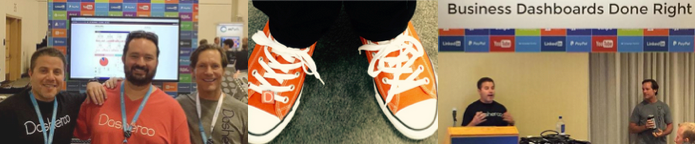
Pics of Dasheroo at Dreamforce 2015.

Four days just “might” be a bit long for a trade show but we tried to make sure we got the best of our spend on this show. For those of you who don’t know, we built a “component” for Dasheroo dashboards using Lightning App builder so you can get your Dasheroo dashboards right in your Salesforce account. Right now it’s only for mobile, but hopefully soon you’ll be able to get them right on your desktop instance of Salesforce.com.

Feedback from the show attendees to Dasheroo? People were pretty happy that there was an easy, lower-cost alternative to Domo, Tableau and Wave which was cool. Some businesses even said they use us alongside those more expensive products to get a quick snapshot of how the business is really doing, then they use those tools to drill into an issue in more detail. Nice, huh?

Bonus? James came up from our Austin office so it was awesome to see him. Since we’re a distributed company we don’t get to see our peeps face to face as often as we’d like, so it was great to all who came out for it. AND everyone donned their fancy new Chucks so we were pretty happy about that. Sorry about your blisters, Jenny!

Newbie on BoardDasheroo's newest addition, Alvaro!

It’s been a while since we hired a new person, so now meet Alvaro Tijero our newest addition to the team here in the Bay Area. He’s no stranger to this group, he used to work with us in sales a lllloooonnnngggg time ago at VerticalResponse. You and Mimi will be a fierce sales team!

On To Q4 growth

We’re going to focus pretty hard on growth for our business and that means rapid integrations, going deeper on some existing integrations and figuring out any triggers to get ya’ll happy about paying. We’re pretty jazzed to give the service for free but when you can get the value you need out of what we provide we hope you’ll pay a modest amount for your business dashboard.

We plan on getting the team together for a day in Austin next month. It’s going to be great to see everyone and get us all on the same page as far as the milestones we really need to be hitting. Can’t wait.

If you haven’t read my Startup Lessons Learned for last week it’s pretty cool: Your Weekly Ops Meeting, you might need to revisit it! I’ve also got an article on Business.com entitled: Help is On The Way: 5 Easy Things To Automate in Your Business.

We’ve got our monthly board meeting to get ready for next week and a ton of catching up this week so I’ve gotta run!

Startup Lessons Learned: Establishing & Revising Your Cash Burn Rate

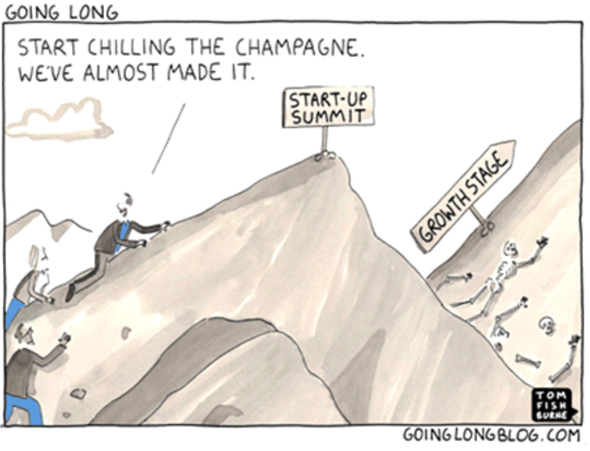
Startup cartoon about startup stage.Whether you raise angel money, seed money or completely blow off taking any outside money for your startup, you need a cost model. A full-on ‘what cash is going out the door?’ model. In my opinion this is way more important at the inception of a startup, than some fancy accrual-based accounting model. Your cash burn rate, and cash management, is king. I may be slightly biased on that approach since I have a finance, not accounting, background but most folks I talk to agree.

You want to go into this process with your eyes wide open on both the cost and revenue side of your early stage business. As good as things may go, new customers and sales may start later or ramp slightly slower than anticipated, and costs are usually the opposite!

One of the first projects I took on after we decided that Dasheroo was ‘a go’ was just this, developing a cost model. I’m not calling it a revenue model because I knew although we would drive some sales early on, it’d be all about investing to establish and grow our team and product offering. Nobody’s going to pay for a 1/2-ass product, at least not for long.

It’s also really important to identify your big costs. There will always be some gotchas that you just didn’t anticipate, like that cool project management software that costs $50 a month. Oh well. As long as you don’t miss a ton of those you should be OK.

So where should you start? First, I think an initial 18-month cost model is a good place to start. Much beyond that is all B.S…I mean, conjecture. And, as detailed as you should be, you should focus on your big ticket items! At Dasheroo, we are leveraging our business freemium model to minimize marketing costs, so the real big expense is people. Our biggest expense categories are:

  • Full time employees
  • Contractors
  • To lesser amounts:
    • Legal & accounting (since we did raise an A round, legal fees were significant)
    • Rent (as we are mainly distributed team, rent is for a small Austin presence)
    • Marketing & Travel and Entertainment (T&E)
    • Amazon Web Services, where we are hosted
    • Software and back-end ops expenses (software like Zendesk, CRM, project management and Amazon Web Services)

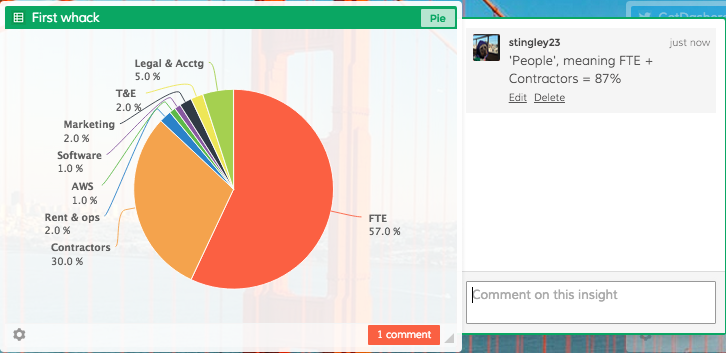
Here was the first whack I took at this in late 2014, for January 2015 out. The actual amounts aren’t so relevant so this shows the distribution of costs across the main areas:

This was my initial cost estimate breakdown for our first 18 months.

This was my initial cost estimate breakdown for our first 18 months.

As you can see, ‘people’ meaning both full time employees and contractors were estimated to make up 87% of our total expenses. That didn’t freak me out, I actually loved it! Great people build awesome things. And especially early on as you are defining and building your product, what else should you be spending on?

This estimate was made before we really had any money to spend, so it was just the best I could do at the time. Note - the total dollar amount also helped guide the amount we needed to raise in our A Round, which was $3.25MM. So, you can do the math!

The model is based on a monthly level of granularity. Other folks do these quarterly, but monthly works best for me. I like measuring on a more frequent basis, and so do my investors.

I then update the burn and input actual expenses each month, and report on variance to forecast to see if there are any big swings I need to take into consideration.

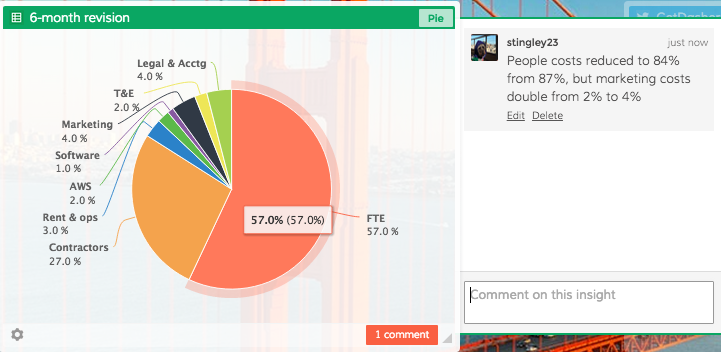
Like I said, things always change, especially when you do have money in the bank. So at least every three months I take a fresh look at what the next months look like. I just did this for the second time, after the initial 6 months of spend. Were there big differences from the original forecast? Let’s see:

This was a subsequent revision after 6 months of real experience

This was a subsequent revision after 6 months of real experience

Any big differences? Nothing shocking, at least from an ‘expense by category’ perspective. as Not huge, and our % held steady by category. People costs ticked down 3% as we dialed in our main out side contractor, and our marketing share doubled from 2% estimate to 4% of total budget. That’s due to us getting some more detail around key events and trade shows that we plan to exhibit at or attend. We still don’t plan on spending any money on Google Adwords.

Now, if you’ve read this far, you may be asking: “Sure, cost share by category held pretty steady, but how about overall expenses. Did they increase or decrease?”

Great question! Yes they did increase, by approximately 3.5% from original. Now, we are in control of most of this, since our Cost of Goods is very low and the majority of the spend is still in people. So if necessary we could delay a hire or two if we choose to do so.

But, you may have noticed this is pure expense burn before layering in any revenue, which we are already generating, so we’re in great shape.

The bottom line here is that you hope your expense projections do remain in line, but as you gain experience use that to revise projections and make sure you are not spending too far in advance of your model. And make sure to get input from, and share with your team members. Everyone needs to understand the state of the business, and how their actions and performance affects expense and revenue.

Startup Lessons Learned - Considering a Probationary Period Hiring Policy

Should you have a 45 day probationary hiring period?Based on our recent experience having to fire a newly hired employee, it got me thinking…should we establish a probation program for all new hires?


The idea immediately resonated with me. Maybe because it was my idea;) Don’t get me wrong, it’s not an original idea, as a few companies out there do have formal probationary periods prior to hiring.

The program would be similar to what our friends at Buffer do with their Buffer Bootcamp:

  • 45-day probationary period
  • An established plan of what success means during at at the end of the probation period.
  • Meet with a senior team member (in our case, each of the 5 co-founders) for a 1:1 during that time.
  • There would be no benefits granted during this time.
  • And, during the probation period the employee gets paid as a 1099 (consultant).
  • The action at the end of the probation period; either get hired as a FTE or we part ways.

What Are The Pros?

  • It may weed out some folks that know they are ‘talking the talk but can’t walk the walk’, as they say.
  • It could save the time and expense of bringing them onto benefits and payroll.
  • There is no employee-employer relationship, meaning we may lessen the need for any type of severance and of litigation.
  • And most importantly, have more confidence that there is a mutually beneficial business relationship.

What Are The Cons?

  • We could lose some very strong candidates who don’t want to jump through the hoops and leave a full-time job to “maybe” get a job. Or just take another job offer that doesn’t have this hoop.
  • We may be on the hook to pay them for the full 45 days even if they don’t stick around that long.
  • Any more?

After a call with our legal guys and doing some other research, I learned a few things:

  • You really have to look at where your employees reside; there are state-by-state regulations to consider.
  • In CA if they’re doing the job of a full time employee they should be paid as such. Uber is having a huge issue with that ruling. One way around this could be to set the probationary period up as a set ‘project’ with a specific start and end date (the length of your probationary period).
  • A contractor relationship doesn’t guarantee less of a obligation to the worker, nor does it shield you any more from potential litigation. In California, a company like Dasheroo actually has as much, if not more, rights in employer-employee relationships by hiring folks.

So what are we going to do?

It’s always a little murky. Bottom line is we always want to do right by, and respect people. But it’s a two-way street and we take our business very seriously. The difference between hiring an A-player and someone else who may not ‘cut it’ has huge negative affects: the cost of on-boarding, and the lost time you’ll never recover in the productivity you expected.

So, we’re probably going to take a hybrid approach to the situation: continue to hire on a traditional full time employee basis, but start to follow a 45-day plan that mirrors most of Buffer’s probation program. A 45-day on-boarding process with weekly 1:1s with senior team members, a very clear action and progress plan by week, and at the end of the 45 days a meeting with the hiring manager to make sure there’s a mutually beneficial working relationship. Will we go as far as Zappo’s, who we really admire? They actually offer to pay people $2000 to go away after the first few weeks. That practice is ballsy and I love it! But it can also take an HR infrastructure that we, and most other startups don’t have. And it can get costly and abused.

So like I said, it’s a 2-way street, it is incumbent upon our folks to properly vet potential new team members prior to hiring, so many times you can find yourself in a ‘hair on fire’ moment when you just need to fill that gap. Fight that temptation, take a little more time to get to know your potential newest A-player and you’ll win in the end.

Startup Lessons Learned - Cutting The Cord Always Sucks

Donald Trump - The Apprentice

What would The Donald do? Should you do the opposite?!

Let go, dismissed, terminated, sacked, fired. For simplicity, I’m going stick with the tried and true ‘fired’ when it’s ‘that time’ in this post. Plus, ‘terminated’ really seems too personal. This action should not be about personal feelings, it’s all business.

You know it. It’s just not working out with one of your employees. It can happen with folks you’ve worked with for years, but often times it’s with new hires. What are you to do?

As much as the chemistry and talent match may seem to be there during the interview process, you’re just never going to know if there’s a true fit until they’re hired, given goals and measured on them. It’s similar to the disclaimer mutual funds make when touting their above-market returns: “past performance cannot be guaranteed in the future”, meaning as much success as your newbie may have had in the past, no matter how glowing their references are, you never know how they’ll do in the situation you need them for.

And the sooner you catch it, work on it and act on it, the better.

It’s always the same. So often, when you finally fire someone you look back and tell yourself “I wish I would have done this 3 weeks, or 3 months ago”. It’s human nature, I mean unless your employee is downright mean, lazy or dishonest it’s not pleasant to fire someone.

How long do you give it? There’s no hard and fast rule in my book, you have to trust your gut. Often, you and your new employee need at least a few months to see if you get into a good, productive working groove.

But other times, you know more quickly, as in weeks. And in those cases, it’s best to address your concerns in very concrete terms, establish an action plan for rapid improvement and then take action immediately.

Case in point, we recently hired only our second ‘out of network’ team member. By ‘out of network’, I mean outside of the circle of folks we’ve worked with, trust and just ‘know’ over the long haul, as well the people they respect and refer to be part of the team. It’s a great way to build a team, and we prefer that approach whenever possible. But it’s not always possible in certain situations due to timing or plain ‘ol availability. And hey, fresh personalities and experience and perspectives can be a great addition to any growing team.

But in this case, it was clear from the start that there were serious issues and we had to let this person go within 1 month of joining Dasheroo. And it’s never a pleasant experience, although it did reinforce much of what I’d learned in the past.

First, do your part; it’s a 2-way road and the hiring (and firing) process is a significant investment:

Have a good on-boarding process. Provide information that brings your new hire into the fold. This includes information over and above their individual responsibilities, and should include things like the background of the company, why it was founded, what the vision is, and who the founders are. You should also include a glossary of terms that may be specific to your company or industry, and contact information and brief backgrounds of all, or key, team members. At Dasheroo, we created what we think is a great on-boarding package, complete with all the above, plus actual how-to training videos specific to the new hire’s job.

Set clear expectations: The more senior the position, the less point-by-point specific you should have to be regarding exact task deliverables. But for more junior to mid-level hires, set specific, task-level goals that are easy to measure against, like meeting a specific schedule, or the quality of work in a given discipline whether it be coding, writing or speaking to people.

Be honest: There is no room to slip into passive aggressive behavior. If your employee doesn’t know that you are disappointed, or plain pissed off, with their performance it’s your fault. You have a responsibility to address it head on. Be direct and factual, and provide specific examples of the performance or behavior at issue.

Be constructive: Show your employee a path to success. A way to improve, with specific examples of what they need to do in order to meet your expectations. Again, at the most specific level possible. Are they using all the tools available to them? Are they prioritizing their tasks effectively?

Take action! If you have devoted your time to the above actions, and it’s just not working, or looking like it’s not going to work anytime soon, cut the cord and fire that person. Be factual and direct and do not apologize. In my experience this meeting should be no more than 5 minutes and, it really shouldn’t come as a surprise if you have followed the steps above.

My startup lessons learned? It’s a business, not personal decision, and the quicker you take decisive action the better – for your team’s moral & productivity, your respect, and your investors.

What’s your experience and thoughts on this subject? Let me know!

Startup Lessons Learned: Be Fluid & Pivot!

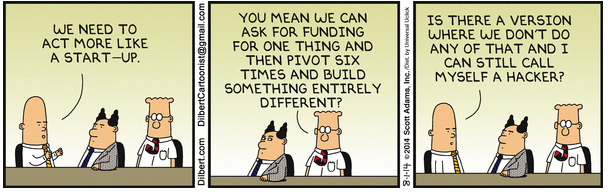
Dilbert Pivot CartoonThese days it’s important to be able to “change course fast” especially if you’re in a nimble startup environment. Don’t get me wrong you need to set your course and nail a roadmap, but if something comes up that’s going to make you grow faster than normal, you need to think about doing it. These onStartup Lessons Learned week I’m focusing on the right way to pivot the team for a big opportunity.

There are a few questions to ask yourself when considering a pivot:

  1. Am I doing this for just one potential customer or will many customer benefit from a pivot
  2. Does it mesh with our strategic plan?
  3. Will it help us grow faster and gain traction?

If you answered yes to all of these good for you, a pivot is likely in order.

At Dasheroo we’ve been marching down a 5 pt. strategic path to get us to where we’d like to be. The plan did call for some partnerships but they don’t happen when you want them to, they don’t happen over night and they usually happen with a lot of luck coupled with your hard work at seeking them out. One such potential partnership is on the horizon so we had to pivot our team and their time and put some development and marketing effort into this partnership earlier than anticipated.

The first thing on your to-do list is to get your team around it. If you’ve got a great team and the pivot makes sense then they’ll follow the strategic marching orders to the end. So I gathered the team and talked to them about it and we went through it together. As a team we wanted to make sure that pivoting for this partnership:

  1. Will benefit this customer or partner and all that come after, and it does. The work that Alex is doing for this partnership on OAuth gets us working with other partners quicker!
  2. Goes along with what we need to do to grow. We don’t want to spend a ton of money on advertising on Google so getting our product distributed through partnerships is what we need to do and this one could be big.
  3. Hopefully gets us to where we want to be faster and better. If this partnership works the way we’d like it to, we could potentially have a nice pop in growth.

It was important for me to include everyone in on the decision since the entire team will be doing a all of the work. And this team fortunately gets it. There’s no guarantee that it will work wonders for us but everyone understands that giving it our best shot is all we can do.Got a potential pivot coming up? Make sure everyone is on the same page! More on this partnership as we launch.

Startup Lessons Learned This Week: The Power of ‘No’

Image for the Dasheroo Power of No article.As I mentioned in Startup Lessons Learned in the past couple weeks, we’ve launched our pricing and our billing solution. So now that we can actually charge people, we’re getting into sales discussions with agencies and larger companies who are interested in our business dashboards solution. It’s exciting!

That said, we just launched Dasheroo on May 5, so we’re still early on and we don’t yet have all the features and functionality that more advanced users like agencies or consultants want. Features like co-branding our app, dashboard exports, and user roles and permissions.

So, just this past week I’ve been in the unenviable position of having to say ‘No’ (more on that below) to several excellent prospects. “Do you have co-branding?”, “Can I export your dashboards to a PowerPoint?”, “Can I make this dashboard read-only?”

‘No’, we don’t have any of those features yet. Years ago I would have freaked out to not have a pocket full of “Yes” to respond with. I would have felt like a loser, and the pressure to close a sale now would have been immense.

But there are benefits of this powerful, and sometimes feared, word. Let’s take a closer look at ‘No’:

  • It shows some real honesty & confidence; people appreciate that.
  • You can sometimes turn a ‘no’ into a thank you, when the request sounds reasonable but you’re just not sure if you’ll ever get around to it. Occasionally we’ll receive feature requests than actually sound great, but not for the near term. So it’s not a ‘no’, it’s a “Thank you for your suggestion. This feature isn’t on our near-term roadmap, but I’ll get it in front of our product folks to review…”. And we do review each feature request we receive.
  • ‘No’ can often be communicated as ‘Not yet or ‘No, but…”, if that is an accurate statement. For instance, co-branding, dashboard exports, and advanced user roles and permissions are in fact on our near-term product roadmap. People will be patient if they believe that your goals are aligned and you’re open with them.
  • Sometimes a firm ‘No’ is warranted. In the case where one customer may be forcing feature demands on you that will not value the balance of your users, or is just something you feel strongly is not in your best interests. Jason Freid of Basecamp wrote a great article a few years ago, where he noted that a customer requested they provide Gantt Charts as part of their Basecamp project management offering. He duly noted that many other companies already provide Gantt Charts and it’s not something they will ever consider.

After several agency and larger company meetings the past week or so, the results are interesting and encouraging. People genuinely like our user interface, ease of use and pricing. That’s the core of our value proposition. So when we discuss upcoming features and functionality with these folks, we’re driving toward a mutually beneficial solution and inviting them to help define that solution. Plus, we’re often able to provide some short term workarounds in the meantime.

So can forms of ‘No’ actually get you to a yes? It’s looking promising, plus it ensures that we stay true to our product vision, which hopefully will benefit all of our users for years to come.

What’s your take on the pros and cons of ‘No’? Let me know!

Startup Lessons Learned This Week: Setting Our Pricing

Last week in Startup Lessons Learned I discussed the importance of establishing sales strategies on both ends of the business spectrum - from a strong ‘auto convert’ for the SMBs all the way up to big ‘ol enterprise types. What that means is this - folks that will pull out their credit card for a $19 purchase when electronically prompted, all the way up to negotiated contracts in the several of thousands of dollars.

So when deciding on your startup pricing strategy, there are so many important items to consider. But I’m going to focus on the 3 biggies we drilled into when setting our initial ‘auto convert’ pricing, as I feel they establish the foundation of a good pricing strategy. Here we go:

1) Your costs. Evaluate both fixed and especially variable costs. For us, the incremental costs of supporting each new user is relatively low. Our incremental costs get down to efficiently scaling the backend server and database costs, being very efficient with API calls to the 3rd party applications we connect to, and customer support. With a business freemium model like we have, incremental variable costs must remain low. For yours? Who knows, but start with your cost basis, and make sure you are very realistic on your costs now, and how they will change over time, especially if you grow.

2) Your competition. You need to be mindful of the competitive environment. Businesses are very cost-sensitive. Does that mean you need to undercut your competition? Not necessarily. First, try to understand your competitor’s pricing approach. What are they basing it on? Is it per user or per ‘widget’? Figure out their pricing metric(s). If you can understand that you can shape your pricing to be a greater value. And that is really what it comes down to, to win the long term race. Value.

Note: Don’t get too crazed by just one competitor’s pricing. You could whip yourself into a frenzy trying to compete with it, and then they change their pricing the next day!

3) Your value. Here’s where your pricing strategy culminates into a successful business. Answering the question “What do users derive the most value from?” You can’t trick, cajole, or hold important stuff hostage, in order to drive long term profitable relationships with your users. And although price points are a huge consideration, if they are not based on ‘value realized’ it won’t matter.

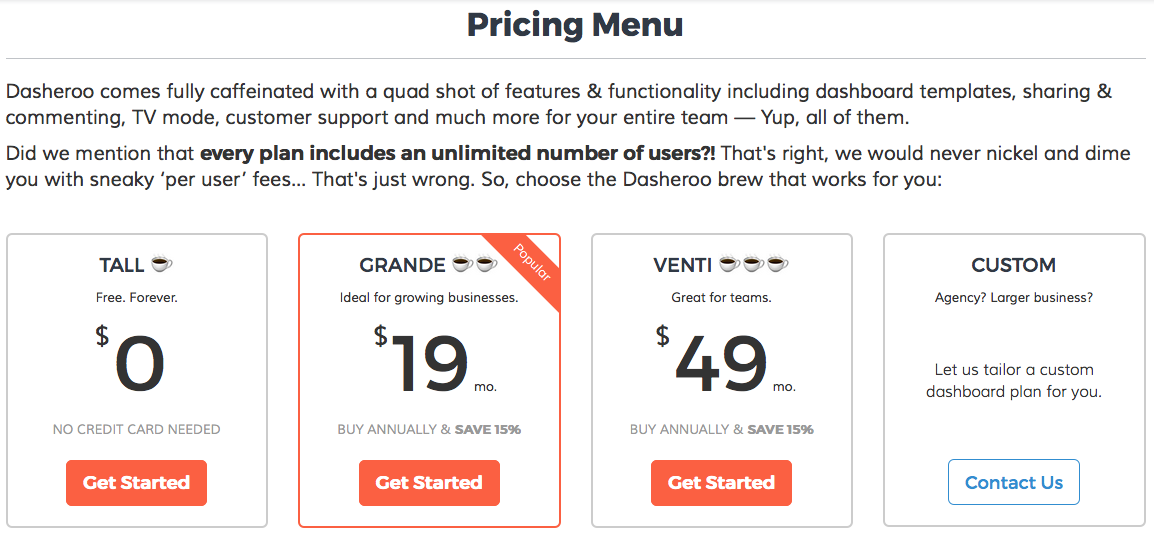
Bottom line, here’s what we did for our SMB auto-convert pricing (I’ll talk agency and larger company pricing in a future post.)

Ou just launched business dashboard pricing

Our just launched business dashboard pricing!

  • Free! We call this our “Tall” pricing tier. We feel business freemium reduces the risk a business takes, and allows for rapid global adoption. Sharp folks like Mailchimp, LinkedIn, Hootsuite and SurveyMonkey have all proven this out. Otherwise, users are forced to make a pay/flee decision after a 14-30 day trial, and often these busy users need a longer period of time to derive value from a product. We felt that leading with a 100% risk-free offer satisfies my three considerations above, provides a huge value, a competitive advantage and fits within our cost structure.
    • We’re big believers in really providing great value in the freemium edition. No stripped down bait-and-switch type stuff. At VerticalResponse (where a lot of us have experience from) we re-tooled the traditional 30-day free trial into a freemium.

Dilbert: Freemium Model Cartoon

  • No ‘per user’ pricing. We really deliberated on this one! Debated. Argued. Hell, I think I argued with myself on this decision! But at the end, we all came to agreement that our pricing should be more like Basecamp’s pricing for project management than Insightly’s per-user pricing for CRM. CRM tools like Insightly naturally lend themselves to a per-user pricing schema, but with business dashboards, you get some users that may casually log in once per month, others that log in daily. So why make people hesitant to invite that casual user?
  • Great conversion price points and clear value triggers. So, the next pricing tiers are Grande and Venti, tipping a hat to Starbucks. You want to achieve a couple things here. First, there are natural price points that tend to drive a conversion. As in our $19 Grande plan. Sure we could have priced at $23 or $16. But we’ve done enough testing in our (long) lives to know that we’ll get as many folks to pay us $19 than $16 (I’ll take an extra $3/month to invest in innovation), and probably drive 30%+ conversions than pricing a couple bucks over the magic $20. Same goes for the Venti pricing. Secondly, our value-add (triggers) are clear. It’s completely usage based. You consume more Insights, we hope it’s clear that you should budget a little more per month for that additional usage, and a couple more bells and whistles.

A guarantee? We’ll most likely change our pricing at some point. As we learn, instrument (we love Mixpanel!) usage, get feedback from our awesome users and add more features and functionality we’ll adjust our prices. But we plan on always treating our current users well, and offer ‘grandfather’ plans to them.

Oh yeah, why the caffienated pricing? It just seemed catchy and fun. Hopefully it’s clear to people, otherwise we may change those labels as well!

Startup Stories: Lessons Learned This Week

This is an exciting week! After several weeks of heads-down development and product work, we’re about ready to release our billing functionality. Maybe that doesn’t sound sexy, but to us it’s where the rubber meets the road…will people pay for Dasheroo? Many have said they will be happy to, so let’s see.

But that’s not the startup lessons learned this week; it’s obvious when you are starting a business that you need to charge for your service. But there’s actually several lessons that this billing project has taught me, and I’m going to focus on a key one now, one that I learned at my last start-up and one that is being reinforced in my experience at Dasheroo.

Dasheroo's diversified sales strategy.

At Dasheroo we’re planning on diversifying our sales to different targeted audiences…are you?

And that lesson is that even with an SMB-focused offering, there’s a huge importance of establishing ‘larger company/enterprise’ sales efforts at the get-go. If that seems contradictory, hear me out. Here are my top 3 reasons we’re pursuing this strategy at Dasheroo:

1) Cash flow: In a business freemium model like we have, it takes a lot of $19 per month transactions to make a dent in the cash burn of our business dashboards company. Sure, it’s vital to build what we call the ‘auto-convert’ side of the business and establish our conversion metrics so we can begin modeling out what the business will look like 3-5+ years down the road. But I was reminded of my experience at my last start-up, VerticalResponse, of the value in generating cash NOW.

Similar to Dasheroo, VerticalResponse catered to the SMB market, providing a self-service email marketing platform. Most users paid less than $15 per month, and we knew we needed to offset our cash burn faster than those smaller sales could support. So we targeted companies with large email lists - e-commerce companies for example, that were happy to pay us thousands of dollars per month for the great email deliverability and VIP support we’d provide.

2) Diversification: Although the global small-midsize business market is well diversified with tens of millions of companies - we already have users in 100 countries from a gay pride foundation in Montenegro to a beauty school in Indianapolis to a dev shop in Guadalajara. But I’m talking more macro-level diversification from a sales perspective. Larger companies behave differently. They tend to buy on an annual vs. monthly basis. They tend to like ‘per user’ pricing and VIP support. All items that provide value to our larger customers that we are then able to charge a premium for.

3) Long term sustainable growth & value: This is an issue that really surfaces after you have achieved a level of success selling to SMBs. The spigot of early adopters tend to dry up a bit over time, and it becomes increasingly difficult to sustain the high sales growth rates of the early days. And ‘increasing at a decreasing rate’ isn’t something anyone wants to hear.

So have we landed a ‘whale’ yet? Nope, but we’re in advanced discussions with a few that we hope to come to agreements with soon. And it’s not just good for cash flow, it’s great for internal morale and to position Dasheroo for a better chance of providing long term value to our investors, and potential acquirers.

One note - take caution that one ‘whale’ doesn’t pull you out to sea with one-off feature demands that aren’t scalable to the majority of your user base! Happy fishing.