Startup Stories: Lessons Learned This Week

This is an exciting week! After several weeks of heads-down development and product work, we’re about ready to release our billing functionality. Maybe that doesn’t sound sexy, but to us it’s where the rubber meets the road…will people pay for Dasheroo? Many have said they will be happy to, so let’s see.

But that’s not the startup lessons learned this week; it’s obvious when you are starting a business that you need to charge for your service. But there’s actually several lessons that this billing project has taught me, and I’m going to focus on a key one now, one that I learned at my last start-up and one that is being reinforced in my experience at Dasheroo.
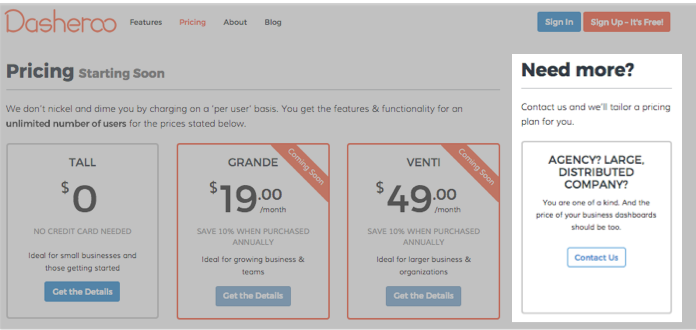
Dasheroo's diversified sales strategy.

At Dasheroo we’re planning on diversifying our sales to different targeted audiences…are you?

And that lesson is that even with an SMB-focused offering, there’s a huge importance of establishing ‘larger company/enterprise’ sales efforts at the get-go. If that seems contradictory, hear me out. Here are my top 3 reasons we’re pursuing this strategy at Dasheroo:

1) Cash flow: In a business freemium model like we have, it takes a lot of $19 per month transactions to make a dent in the cash burn of our business dashboards company. Sure, it’s vital to build what we call the ‘auto-convert’ side of the business and establish our conversion metrics so we can begin modeling out what the business will look like 3-5+ years down the road. But I was reminded of my experience at my last start-up, VerticalResponse, of the value in generating cash NOW.

Similar to Dasheroo, VerticalResponse catered to the SMB market, providing a self-service email marketing platform. Most users paid less than $15 per month, and we knew we needed to offset our cash burn faster than those smaller sales could support. So we targeted companies with large email lists - e-commerce companies for example, that were happy to pay us thousands of dollars per month for the great email deliverability and VIP support we’d provide.

2) Diversification: Although the global small-midsize business market is well diversified with tens of millions of companies - we already have users in 100 countries from a gay pride foundation in Montenegro to a beauty school in Indianapolis to a dev shop in Guadalajara. But I’m talking more macro-level diversification from a sales perspective. Larger companies behave differently. They tend to buy on an annual vs. monthly basis. They tend to like ‘per user’ pricing and VIP support. All items that provide value to our larger customers that we are then able to charge a premium for.

3) Long term sustainable growth & value: This is an issue that really surfaces after you have achieved a level of success selling to SMBs. The spigot of early adopters tend to dry up a bit over time, and it becomes increasingly difficult to sustain the high sales growth rates of the early days. And ‘increasing at a decreasing rate’ isn’t something anyone wants to hear.

So have we landed a ‘whale’ yet? Nope, but we’re in advanced discussions with a few that we hope to come to agreements with soon. And it’s not just good for cash flow, it’s great for internal morale and to position Dasheroo for a better chance of providing long term value to our investors, and potential acquirers.

One note - take caution that one ‘whale’ doesn’t pull you out to sea with one-off feature demands that aren’t scalable to the majority of your user base! Happy fishing.
Insight Riot
Vote for your favorite app and we'll build it a Dasheroo Insight — Vote Now

Startup Lessons Learned: Hiring in Another State

OK, this may not be the sexiest post in the Startup Lessons Learned series, but it’s about one of those things that’s so easy to ignore, or in my case, not even think about when bringing on new team members in different U.S. States - registering your business to do business in that state!

I casually mentioned in a recent board meeting (remember that post about productive board meetings?) that we were building our presence in the lovely city of Austin, Texas and my lawyer’s ears perked up. “Are you registered in Texas?” Emma asked. And semi-confidently, I replied that yes, although we are based in San Francisco, the great folks at ZenPayroll had prompted me to fill out some various forms when I was adding my Austin-based folks to payroll (BTW, we love ZenPayroll, it’s super easy to use, very complete and just a very well done & affordable app.) So I thought I was all done. Not so fast, she said.

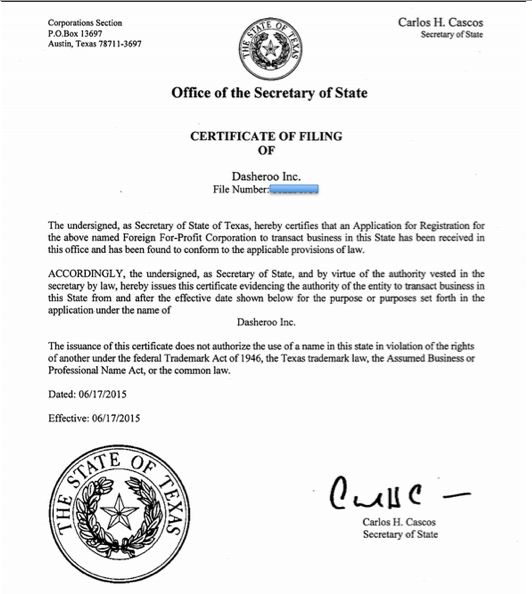
I also had to file a form to be ‘qualified’ to do business in the great state of Texas. It’s an Application for Registration of a For Profit Corporation (the TX Version). It’s an easy form to complete, and just asks for basic info like your business name & address, EIN #, names and addresses of company officers, and the address of the office (even if it’s a home office) in Texas. Oh yeah, plus $750 filing fee. And in about a week, Dasheroo was ‘legit’ to do business in Texas:

Signed, sealed & delivered - we're now legit to do business in Texas

Signed, sealed & delivered - we’re now legit to do business in Texas

We now have our first team member in Georgia. And now I know! Even though ZenPayroll does an awesome job of prompting me with any new payroll-oriented forms to complete, including Department of Revenue (need that payroll tax income!) and Department of Labor forms, there’s still that business registration form that needs to be filed with the Secretary of State.

So especially if you’re building a distributed team for your new business, remember to always check to see if you’re required to register your business in that state. I’m pretty sure every state requires it. It’s more of a housekeeping task than anything else, but take care of it at the get-go, right when you’re adding your next team member in a new state. Plus you’ll avoid potential fines down the road. Who needs that?

Insight Riot
Vote for your favorite app and we'll build it a Dasheroo Insight — Vote Now

Startup Lessons Learned: The Importance of Employee On-boarding

Seems like we’re hiring like crazy lately! Suddenly every one of the co-founders of Dasheroo has at least one direct report. Wow. We are officially up to 13 awesome people - 10 cranking away now, 2 more signed and one ‘secret weapon’ we’ll announce soon!

We’re actually going to hold off on any more new hires, it’s kinda of like letting your food digest after you’ve had a big ‘ol meal. Plus, we need to start generating some $$ to offset our investment in our team.

OK, like I mentioned before we are a distributed work environment, with folks all over the SF Bay Area, Austin, Atlanta and a sprinkling of additional developers in Malaysia & Siberia. So the topic of onboarding our new people is something we feel especially strong about! It’s super key to communicate our story, our competitive benefits, our expectations, our tools and give a feel of our culture. This is even more important as we hire folks outside of our ‘family’, people we don’t have prior work experience with.

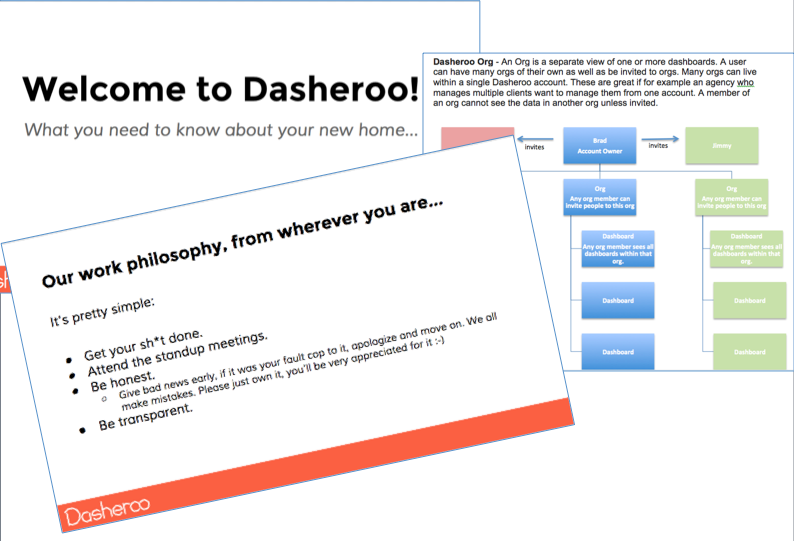
So what’d we do? We developed a couple cool Google docs, that’s what. One is called Onboarding Newbies and the other is simply, Dasheroo Glossary. We really have to work on some jazzier titles for these, but they are chock full of great info, all to get our next A-team Dasherooer up to speed in a flash.

(almost) all the basic info a newbie needs to get up and running fast & efficient at Dasheroo!

(almost) all the basic info a newbie needs to get up and running fast & efficient at Dasheroo!

The glossary includes not just our internal lingo, like ‘what’s an Insight?’ but also industry terminology, like defining what an API (Application Protocol Interface) is and why these are important to our business.

The on-boarding doc includes cool info like our story (why we started Dasheroo), information on each of our team, and our values.

We just shared these docs with our new Social Media Marketing manager, Karen on day 1. And for sure, they will be working docs. For instance I just shared these with our Director of Sales, Mimi, who has been here for 3 weeks. She’s already provided info she wished she would have had on her day 1. Awesome!

We’ve also used Screenflow to create videos on how we do things, for instance like email marketing. A) It’s a great help to the new person who needs to learn how we do it and 2) they can refer back to it without continually asking questions.

Speaking of, I need to work on a Screenflow to record a demo to get folks comfy on how we position our product. That’s coming soon, as I’m sure lots of other helpful stuff as we get feedback from our newbies.

Now I wish we would have done this a couple months ago so all new folks could have had it, but hey it’s better to start it at Employee #10 than never!

What are your plans or policies for employee on-boarding? Let me know!

Insight Riot
Vote for your favorite app and we'll build it a Dasheroo Insight — Vote Now

Startup Tips - Lessons Learned This Week: Distributed Teams

Hi there! I hope you’re doing great, and that there’s some helpful startup tips in this week’s post.

This week, the biggest lesson I’m learning, will continue to learn, and hopefully get right (!) is building a distributed team. After 2 startups and mostly employing people in San Francisco, I don’t want to default into that way of thinking this time around. At least not yet. It’s tough here - rents are insane, competition for great talent is enormous, and…hate to say it but many folks here really seem ‘entitled’. I don’t need it. I’m not saying I won’t hire folks from the Bay Area, but it is definitely not a prerequisite nor does it give anyone an advantage when we consider who to bring on to our team.

First, why I decided to build a distributed team:

  • I’m not convinced people get more done jammed into one office. There’s a lot of distractions! I’ve experienced it many, many painful and expensive times.
  • Like I said, San Francisco is ridiculously expensive to hire and rent. I know, I live here!
  • Aside from the fact it’s SF, why not hire for ‘talent over zip code’?
  • Mature people appreciate the flexibility, and that should show in loyalty and productivity. Plus, I like working with (fun) mature people!
  • I am convinced you get the opportunity to build a more diverse group of people, and I like that. I think it breeds innovation.

Some things I am learning:

  • First - if you don’t keep up with Buffer, you need to. A big tip o’ the hat to co-founders Joel and Leo, they rock it. They are building a very successful, distributed team and are so transparent about how they do it. Lots of stuff to learn from these guys, thanks for the tips on your blog. If you’re ever in SF let me buy you several beers.
  • Like I said, bring on ‘talent over geography’. It also helps if your newbie has worked in an environment like this before. We recently talked to a great product marketing person, but after we talked a bit more, he really wanted the social aspects of working with other folks in an office.
  • If you are gonna do this, do it from the get-go. Retrofitting a more traditional office/HQ-based company to a distributed team would pose a significant challenge!
  • Just because there’s ‘no rent’ doesn’t mean there’s ‘no cost’ to supporting this structure. You may need more tools, more apps, more management time to make this work. And for sure you need to get everyone together periodically for some f2f time and fun. Is it quarterly? semi-annually? I’m not sure yet, but 3-4 times a year smells about right. That’s not free! But make it count, don’t cheap out.
  • And speaking of structure, even though it may seem less structured in many ways (working from home, easier to break off and take care of personal business, etc.) in fact a distributed environment does demand a ton of structure - trust, clear communications, great tools.

    Team Dasheroo at their offsite!

    Team Dasheroo all together!

  • Trust. Even more that ever. Transparency & trust. Do you feel it? Do they earn it?

We just had an all-hands meeting here in San Francisco. Hey, we’re 8 people. It’s pretty manageable, but it was really full of great energy, awesome ideas and bonding. We had it at my house, then ate great Mexican food at Don Pistos in North Beach.

Are you building a distributed team? Successes, hard lessons learned? Let me know!

Insight Riot
Vote for your favorite app and we'll build it a Dasheroo Insight — Vote Now

How Cheap Can it be To Start A Tech Company?

It’s amazing how affordable it can be to develop and support your new application in a world class way. Here’s how our brand-spakin’ new company Dasheroo (affordable, scalable and powerful business dashboards no matter your business size) is starting out!

We just completed the pro-forma budget for Dasheroo, and compared to what it would have cost even a few years ago, it’s amazing! A big shout-out to you, Cloud and SaaS! Buying and scaling your own servers & hardware? Nope, at least not in the foreseeable future, thanks to Amazon EC2. Time-consuming programming to develop web apps and make them mobile-friendly? Not with Bootstrap (yes, it’ll be free). And then all the affordable business apps we’re using, or planning to when the time is right:

  • Agile product development tracking - Pivotal Tracker, $18/month

  • Front-end mobile friendly web development - Bootstrap, Free

  • Code hosting & collaboration - Github, $25/month

  • Product wireframes - Balsamiq, $12/month

  • CRM - Zoho or Insightly, Free to $12/month

  • Support - Zendesk or Zoho, Free to $25/month

  • Team Collaboration - Basecamp, $8/month

  • Billing - PaySimple or Braintree, no minimums! From 2.3% + $0.29 per transaction to 2.9% + $0.30 per transaction. (Note: make sure you really dig into revenue recognition capabilities before deciding!)

  • Google Apps - $5/month per user

  • Accounting - Kashoo, $20 per month

  • Payroll - ZenPayroll, $65/mo for less than 10 employees

  • Blog - WordPress, $10/month

  • Social - Twitter, Facebook, and well, you know use the ones most pertinent to your biz., Free + advertising costs

That’s less than a couple hundy per month. Plus, all of the above business apps have a free trial option, and many also have a free ‘starter’ plan for limited usage, so you can scale them as your business grows.

So at least big up-front costs don’t stand between you and your dream. There’ll plenty of other challenges for you to slay! That’ll be the model for Dasheroo too - affordable, scalable and powerful business dashboards no matter your business size!

Insight Riot
Vote for your favorite app and we'll build it a Dasheroo Insight — Vote Now